Decluttering With ADHD: A System That Actually Works
For years I read decluttering articles that started with “set aside a full Saturday.” My brain interpreted this as “you will fail.” ADHD does not do full Saturdays. ADHD does 14 minutes of intense focus, then a snack, then forgetting what you were doing.
After being diagnosed with ADHD in my thirties, I rebuilt my entire approach to home management. The system below is what actually works. Not what works for neurotypical brains. What works for mine.
Why Standard Decluttering Advice Fails ADHD Brains
The standard advice (empty everything, sort into 4 piles, finish a whole room before stopping) assumes a brain that:
- Can sustain attention for hours
- Enjoys repetitive sorting
- Tolerates mid-task chaos
- Makes consistent decisions
- Resists distraction
ADHD brains do none of these well. Research from the Cleveland Clinic shows that executive function challenges in ADHD affect task initiation, sustained attention, working memory, and emotional regulation. Standard decluttering taxes every single one of those.
The fix is not to try harder. The fix is to use a different system.
What Works for ADHD Decluttering?
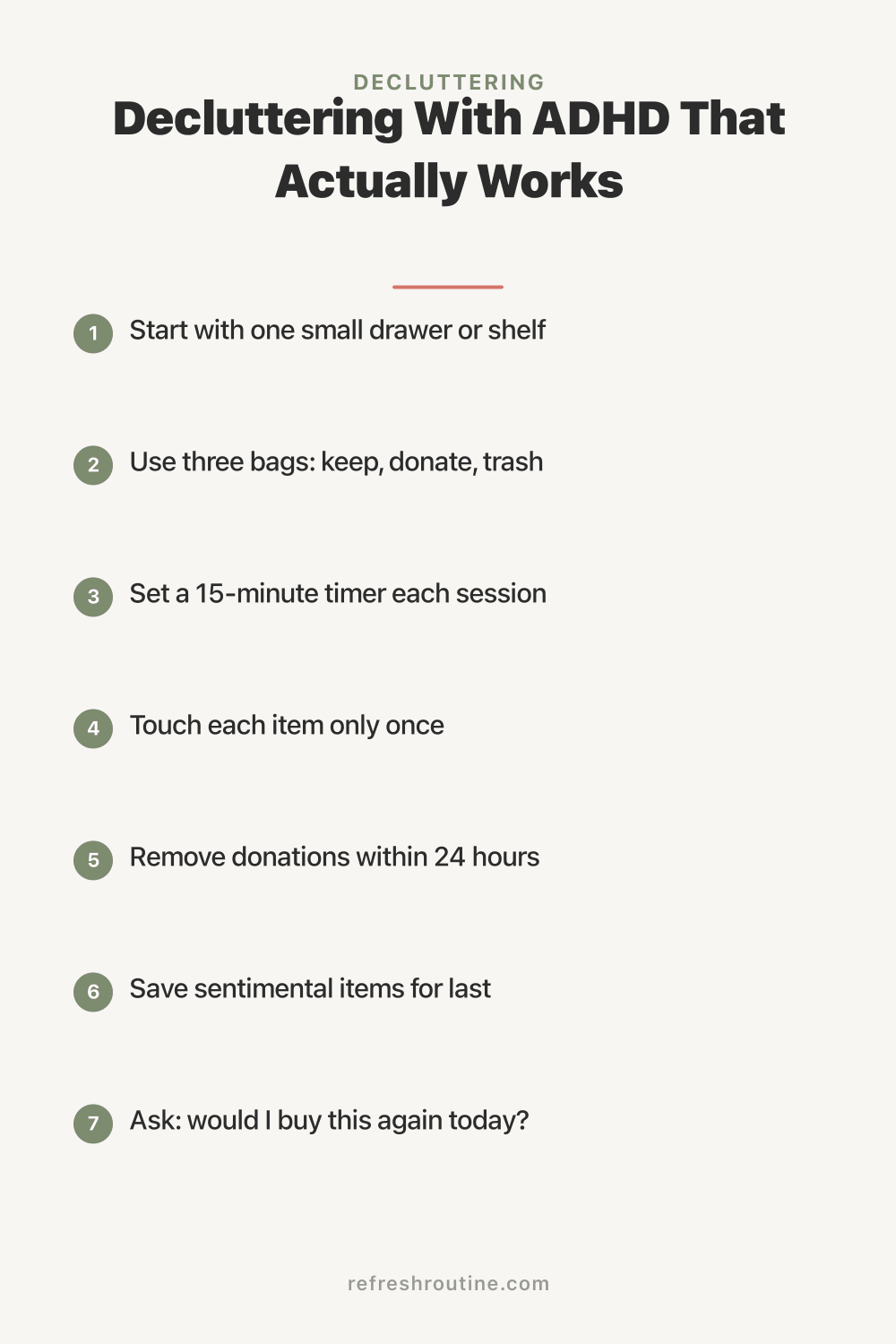
ADHD-friendly decluttering uses short bursts (15 minutes max), single-decision tasks (trash only, no sorting), externally regulated focus (timer, body double, or music), reduced inventory (less to manage), and visible storage (out of sight equals out of mind). This combination works with the ADHD brain instead of demanding it behave like a neurotypical one.
The ADHD Decluttering System
Rule 1: Tiny Sessions Only
Maximum session: 15 minutes. Most days, 10. On low-energy days, 5.
Do not believe yourself when you say “I have time for more.” Set a timer. When it goes off, stop. ADHD brains struggle to recognize when energy is running out. The timer is your prosthetic.
Rule 2: One Decision Type Per Session
Do not sort during the same session as decluttering. Pick one:
- Trash session: Throw away only obvious garbage
- Donate session: Identify only items to donate
- Reset session: Put items back in their homes
- Categorize session: Group like with like
Mixing decision types creates decision fatigue twice as fast.
Rule 3: Body Double or Background Stimulation
ADHD brains often need external input to focus. Options:
- Video call with a friend (they work on their own thing)
- ADHD body-doubling services (Focusmate, Caveday)
- Family member in the same room
- Loud music or podcast you have heard before
- TV show as background noise (something you have seen)
I personally use rerun episodes of shows I love. New content is too distracting. Familiar content fills the dopamine need without stealing focus.
Rule 4: Visible Storage
ADHD brains forget items they cannot see. The classic “everything has a home and the home is hidden in a drawer” advice does not work.
Use:
- Open shelving
- Clear bins
- Hooks on walls
- Pegboards
- Front-facing labels
- Glass containers in the pantry
If you cannot see it, you will buy a replacement and clutter will grow.
Rule 5: Reduce, Do Not Organize
Organizing 100 t-shirts is harder than owning 30 t-shirts. ADHD-friendly homes have less stuff, not better-organized stuff.
For every category, ask: “How many do I actually use in a typical week?” Multiply that by 3. That is your ceiling. Donate the rest.
This single rule changed my life. I went from 60 t-shirts to 18 and never miss the others.
What I Wish I Knew About Decluttering With ADHD
After 10 years of failing at neurotypical methods, here is what helped.
Stop apologizing. I used to declutter while ashamed of how cluttered the house was. The shame burned more energy than the decluttering. Now I treat clutter as a neurological reality, not a moral failure.
Reward dopamine immediately. ADHD brains run on dopamine. Reward each session immediately. A snack, a show, a walk, a phone scroll. Do not save rewards for “after I finish everything.”
The first 30 seconds are the hardest. Once I start, momentum carries me. The fight is in the seconds before starting. I use rituals to bridge: put on shoes, set timer, start music. The ritual triggers the action.
Cluttered shelves are okay. I used to want Pinterest-perfect shelves. I now have functional, slightly messy shelves where I can see everything. The functionality matters more than aesthetics.
Build dump zones. I have a single bowl by the entry where keys, mail, sunglasses, and pocket items go. No sorting. Just dumping. Once a week I empty it. This prevents the floor from becoming the dump zone.
How Do You Stop Hoarding With ADHD?
Stop hoarding with ADHD by addressing the trigger (often anxiety about future scarcity), creating clear donation pathways (open box near door, immediate car drop-off), and using one-in-one-out rules. Many ADHD adults benefit from working with a therapist on the emotional component of acquiring and keeping items. The clutter is often a symptom, not the root problem.
ADHD-Specific Tools That Help
These tools were game-changers for my system:
Visual timers: A physical timer (Time Timer brand or similar) shows time passing. Better than a phone timer because the phone has other apps.
Label maker: Front-facing labels reduce the cognitive load of remembering where things go. Worth the $30.
Clear stackable bins: See contents without opening. Worth $50 to $100 for a kitchen setup.
Magnetic spice jars: Spices on the fridge or wall instead of in a cabinet. Visible equals usable.
Hooks everywhere: Coats, bags, towels, keys all go on hooks. ADHD-friendly because the action is faster than folding or hanging on a hanger.
The 5-Item Daily Habit
To prevent clutter creep, do this every evening:
- Walk through your main living space
- Pick up exactly 5 items that are out of place
- Put them back in their homes
- Stop after 5
Five items takes 90 seconds. It prevents the gradual buildup that overwhelms ADHD brains. Done daily, your home stays at a manageable baseline without weekend marathons.
What to Do When You Lose Steam Mid-Project
ADHD decluttering often stalls partway. Half the closet is empty, the bed is covered in clothes, and you cannot finish. This is normal.
Permission to pause: Pack everything currently visible into one labeled bin: “Mid-Project, finish [date 3 days out].” Put the bin out of sight. Reset the room enough to function.
Schedule the restart: Add the bin’s reopening to your calendar. Without a calendar entry, the bin disappears mentally.
Restart with a different category: When you reopen the bin, pick a different sorting category to keep the brain engaged. Did you sort by color last time? Sort by season this time.
Accept partial wins: A half-decluttered closet is still better than the cluttered original. Done is better than perfect.
Resources for ADHD Decluttering
If you want more support, these resources go deeper:
- CHADD for ADHD information and community
- ADHD-focused therapists (look for ICF or LMFT credentials with ADHD specialty)
- Body-doubling apps (Focusmate, Cofocus)
- KC Davis on YouTube and TikTok (struggle care)
You are not lazy. You are not broken. You have a brain that needs different tools.
Key Takeaway
ADHD decluttering works when you stop trying to copy neurotypical methods. Use short bursts (15 minutes max), one decision type per session, external focus support (body double, timer, music), visible storage, and reduced inventory. Most importantly, treat the work as ongoing maintenance, not a one-time project. Five items a day prevents the buildup that overwhelms ADHD brains. The system is not pretty, but it works. Three years into using this approach, my home is functional, my brain is calmer, and I no longer dread the word “declutter.”
For more on starting when overwhelmed, see our decluttering when overwhelmed guide. To avoid common pitfalls, check our decluttering mistakes post.

Frequently Asked Questions
Why is decluttering so hard with ADHD?
Decluttering is hard with ADHD because it requires sustained attention, executive function, and decision-making, which are all areas affected by ADHD. The brain seeks novelty and resists repetitive sorting. Visual clutter also overstimulates the ADHD nervous system, creating overwhelm before you even start.
What is the body double method for ADHD?
Body doubling means having another person physically or virtually present while you complete a task. They do not need to help. Their presence alone provides accountability and externally regulates focus. Many ADHD adults use video calls with friends, online body-doubling services, or family members in the same room to make decluttering possible.
How do you maintain an organized home with ADHD?
Maintain organization with ADHD by reducing the number of things you own (less to manage), using visible storage (out of sight equals forgotten), creating dump zones for transition moments (entry, exit, bedside), and building tiny daily resets into existing routines instead of trying to remember separate cleaning tasks.