The 15-Minute Daily Declutter Habit That Transforms Your Home

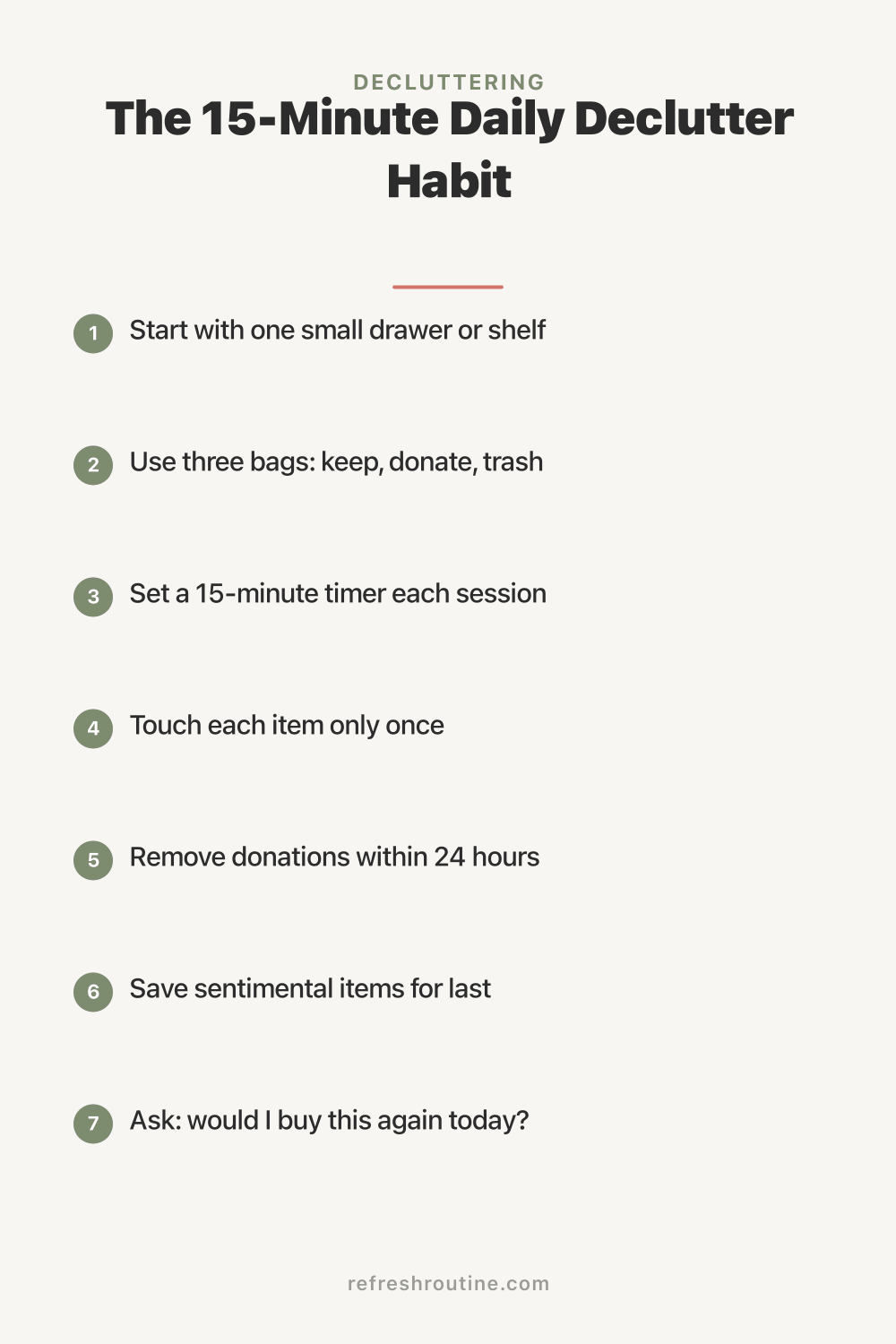
I tried to declutter my house in one weekend. I spent 16 hours, made enormous progress, and was so exhausted that the house drifted back to cluttered within 8 weeks. The next year I tried again. Same result.
Then I switched to 15 minutes a day. No marathons. No bins on every surface. Just 15 minutes daily for 6 weeks. The home transformed and stayed transformed. Here is the exact routine.
Why Daily Beats Weekend Marathons
Behavioral psychology consistently shows that small daily actions outperform large infrequent ones. The reasons:
- Cumulative effect: 15 minutes daily = 91 hours yearly
- Habit formation: Daily actions become automatic in 30 to 60 days
- No burnout: Short sessions stay sustainable
- Maintenance built in: New clutter cannot accumulate to overwhelming levels
- Lower decision fatigue: One small decision at a time
According to research from Stanford’s Behavior Design Lab, behaviors that take under 30 seconds to start (and under 5 minutes to complete) stick far longer than larger commitments. 15 minutes is the sweet spot: long enough to make progress, short enough to never skip.
What Is the 15-Minute Daily Declutter?
The 15-minute daily declutter is a habit of dedicating 15 minutes each day to small decluttering tasks. The work is divided across the week with specific assignments: Monday for surfaces, Tuesday for one drawer, Wednesday for the entry, and so on. The accumulation of daily sessions transforms a home over weeks without the burnout of weekend marathons.
The 15-Minute Weekly Schedule
Monday: Surface Reset (15 min)
Reset visible surfaces in main living areas. Counter tops, coffee table, dining table, entryway console. Items go back to their homes; trash gets tossed; mail gets sorted.
This single weekly task prevents 80% of visual clutter buildup.
Tuesday: One Drawer Day (15 min)
Pick one drawer anywhere in the house. Empty it, sort contents (keep, donate, toss), and put back only what belongs. Rotate which drawer each week.
In 26 weeks, you cover 26 drawers, which is most drawers in a typical home.
Wednesday: Entry Zone (15 min)
Decluter the entry area: shoes, coats, bags, mail. Items belong here only if they support daily transitions. Take photos of any items waiting for “later.”
Thursday: One Room Touch-Up (15 min)
Pick a different room each week. Quick walk-through: pick up out-of-place items, dust the highest-traffic surface, take a photo of progress.
Friday: Closet or Wardrobe Edit (15 min)
Pull out 5 items you have not worn in 30 days. Decide: keep, maybe (try on this weekend), donate, toss.
Over a year of Fridays = 260 items reviewed, which is most of a wardrobe.
Saturday: Donations Out (15 min)
Take any accumulated donate items to a drop-off location. This single Saturday habit prevents donate piles from becoming clutter themselves.
Sunday: Plan and Reset (15 min)
Review the week. What surfaces need attention? What is the focus drawer for Tuesday? Set up donation bag for the week.
What I Wish I Knew About Daily Habits
After 3 years of running this routine, here is what made it stick.
Same time daily matters. I do mine at 6 AM before kids wake up. Pick a time that does not require willpower (after coffee, before TV, etc.).
Start with 5 minutes if needed. If 15 feels like too much, start with 5. The habit is more important than the time. You can grow it later.
Set a literal timer. Without a timer, 15 minutes drifts into 45 minutes and burnout. The timer is the boundary.
Music helps. Pick one specific song or playlist that is exactly 15 minutes. When it ends, you stop. The audio cue makes the habit feel ritualistic, not chore-like.
Track on paper. I have a simple checklist taped inside a cabinet. Checking off the day is its own reward.
What If You Miss a Day?
Missing one day is fine. Missing two days is normal. Missing three days needs a small reset.
One missed day: Skip and continue the next day. No catch-up needed.
Two missed days: Do 5 minutes the third day to break the inertia. Resume normally the fourth.
Three or more days: Reset by doing one big 30-minute session and then resuming the daily 15-minute habit.
The goal is the habit, not perfection. People who maintain daily habits long-term miss 5 to 10% of days. They just do not let missed days become a reason to quit.
How Long Until You See Results?
You will see visible results in 14 days. Significant transformation by day 60. Most homes are fully decluttered in 4 to 6 months of consistent 15-minute sessions. The biggest improvements come from the consistency, not the intensity. Many people see better results from 15 minutes daily than they did from full weekend marathons.
Customizing the Daily Schedule
The example schedule above is a starting point. Customize based on your home:
Apartment dwellers: Less garage/yard time, more focused on small interior spaces
Families with kids: Add a daily 5-minute toy reset
Empty nesters: Heavier focus on accumulated paper and storage
Renters: Less focused on permanent fixes, more on maintenance
Hoarders or recovering hoarders: Start with 5 minutes and build slowly with support
For specific room strategies, see our room-by-room decluttering checklist.
Sample 30-Day Daily Declutter Calendar
Days 1-7: Visible surfaces (one main room per day) Days 8-14: Drawers (one drawer per day) Days 15-21: Closets (one shelf per day) Days 22-28: Hidden spaces (under sinks, basement, attic) Days 29-30: Reset and review
Adapt this to your home’s specific clutter zones. The point is the daily check-in, not the exact assignment.
Common 15-Minute Declutter Mistakes
After teaching this method to friends and family, these are the patterns that derail success.
Skipping the timer: 15 minutes becomes 90 minutes. Burnout follows. Set a timer.
Aiming for “done”: Daily decluttering is never done. It is ongoing maintenance. Reframe the goal.
Going to the worst area first: Start with the easy wins. Success builds. Failure derails.
Adding extra tasks: If you have time and energy for more, save it for the weekend. Keep daily sessions short and predictable.
Skipping when home looks fine: Daily habit matters even on tidy days. The neural pathway needs the daily reinforcement.
For more on avoiding pitfalls, see our decluttering mistakes post.
Daily Decluttering for Families
If you live with others, the daily habit can include them:
Family 5-minute reset: Each person picks up 5 items before bed Sunday family planning: Everyone identifies one focus area for the week Kid drawer assignments: Each kid handles one drawer per week Partner check-in: Brief weekly review of system effectiveness
The key is making the daily habit visible to everyone in the household, not just one person.
Pairing the 15-Minute Habit with Other Routines
Habits stick when stacked. Try pairing decluttering with existing daily routines:
After morning coffee: Surface reset while caffeine kicks in During podcast or music: 15 minutes of one specific drawer or shelf Before evening TV: One quick room walk-through During phone call: One drawer or shelf while talking
The pairing makes the habit feel less like a chore and more like a natural extension of what you already do.
Maintaining a Decluttered Home Long-Term
After the initial transformation, maintenance becomes the focus:
Weeks 1-12: 15 minutes daily, full focus Months 4-12: 15 minutes daily, sustained focus Year 2+: Same daily habit, but it feels effortless
Most people who maintain the habit for a year never need to do another weekend declutter marathon. The home stays in a stable state because clutter is addressed daily before it accumulates.
For a quick-start system, see our where to start decluttering guide.
Key Takeaway
The 15-minute daily declutter outperforms weekend marathons because it prevents clutter from accumulating to overwhelming levels. Pick a consistent time, set a timer, and follow a weekly rotation of surfaces, drawers, entry, rooms, closets, donations, and planning. After 60 days, the habit feels automatic. After 6 months, your home is transformed and stays that way. The compound effect of 91 hours per year (15 minutes daily) is far more powerful than 1 to 2 weekend marathons. Start tomorrow morning with 15 minutes. The habit, not the time, is the magic.
For when motivation fails, see our decluttering when overwhelmed guide.

Frequently Asked Questions
How much can you declutter in 15 minutes?
In 15 minutes, you can declutter one small space (one drawer, one shelf, or one corner). Over a month of daily 15-minute sessions, you cover 30 small spaces, which is enough to declutter most homes thoroughly. Consistency beats intensity for lasting results.
When is the best time to declutter daily?
The best time to declutter daily is either first thing in the morning (before mental energy depletes) or right before bed (as part of a wind-down routine). Choose whichever fits your natural rhythm and stick to it. Same time daily builds the habit fastest.
What is the difference between daily decluttering and weekly?
Daily decluttering (15 minutes) prevents clutter from accumulating in the first place. Weekly decluttering (60 to 90 minutes) handles bigger projects and resets areas that need more attention. Doing both is ideal: daily for maintenance, weekly for deeper work.