Daily Cleaning Routine: The 15-Minute Tidy That Keeps Your Home Clean

Here’s something professional cleaners know that most of us don’t: a clean house isn’t the result of long weekend cleaning marathons. It’s the result of small daily habits that take less time than scrolling through your phone.
The 15-minute daily cleaning routine is exactly what it sounds like. It’s a set of quick tasks you do every day that prevent messes from piling up. After trying a dozen methods over the years, this is the one that actually stuck for me. Once it becomes a habit (about two weeks in), your home stays consistently clean without ever feeling like a chore.
Why 15 Minutes Works
Traditional cleaning advice tells you to spend your Saturday scrubbing the house for four hours. That works great for about two days. Then the mess builds up again, and you’re back to square one by Wednesday. I lived that cycle for years.
The daily maintenance approach flips this entirely. By spending just 15 minutes every day on high-impact tasks, you prevent the mess from ever getting out of control. Your home stays at a baseline level of clean, and your weekend deep cleans (if you even need them) take a fraction of the time.
According to a study by the American Cleaning Institute, people who clean a little bit every day spend an average of 6.2 hours per week on housework. People who do everything in one big session spend closer to 8.5 hours. Daily cleaning is not just less stressful. It actually saves you time over the course of a week.
A survey from the Bureau of Labor Statistics found that the average American spends about 1.1 hours per day on household activities. When you consolidate the cleaning portion of that into a focused 15-minute block, you free up the rest of that time for things that actually matter to you.
How Long Does It Take to Build a Daily Cleaning Habit?
It takes approximately 14 to 21 days of consistent practice to turn a daily cleaning routine into an automatic habit. During the first week, you will need to remind yourself and use a timer. By the second week, the routine starts to feel natural. After three weeks, most people report that it feels strange to skip a day. The key is consistency. Even a 5-minute version on hard days keeps the habit alive.
The 15-Minute Daily Checklist
Set a timer. Seriously, the timer is what makes this work. When you know you only have 15 minutes, you move faster, skip perfectionism, and focus on what actually matters.
Minutes 1-5: Kitchen Reset
The kitchen gets messy every single day, so it gets attention every single day. This is the most important chunk of the routine.
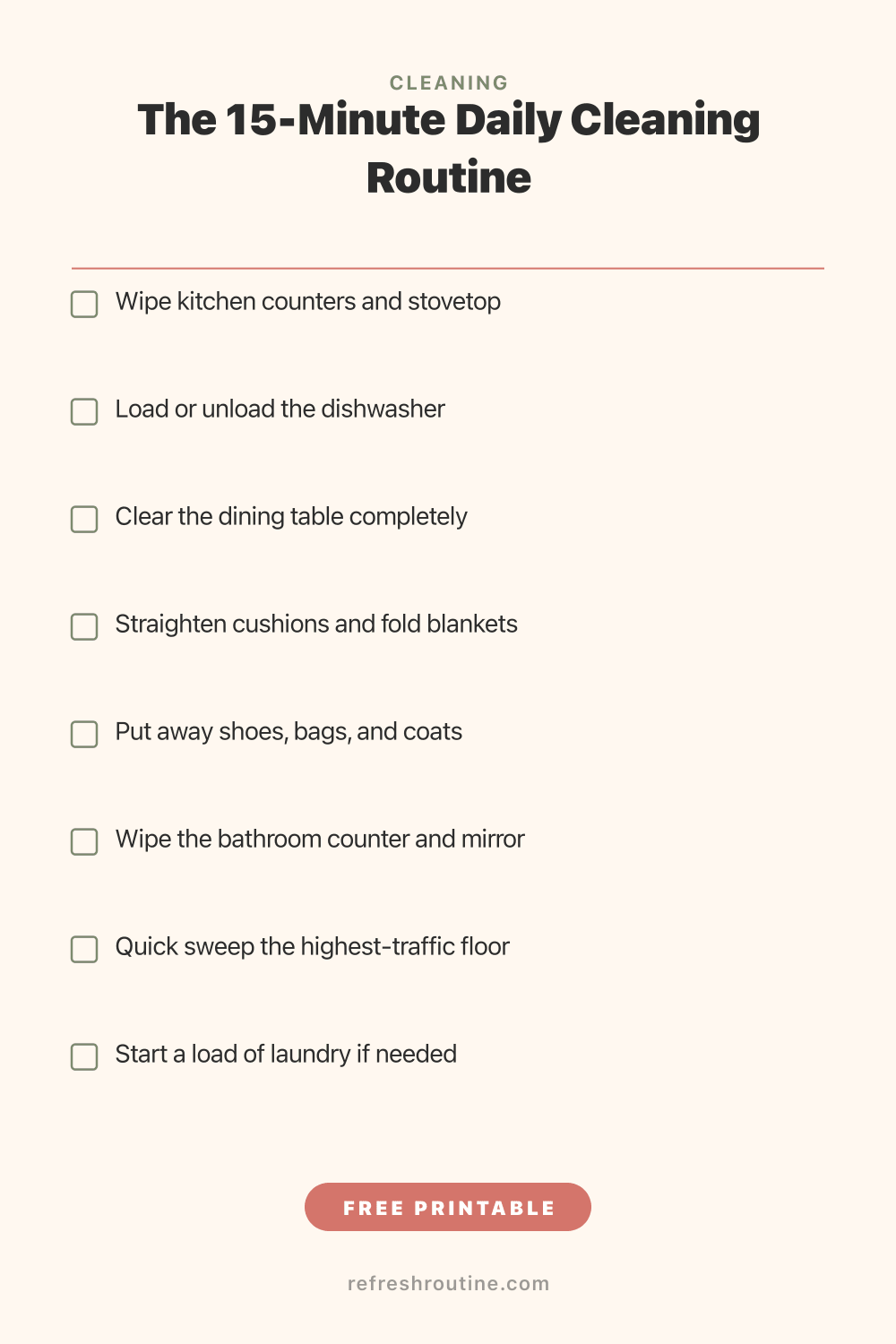
- Load or unload the dishwasher
- Wipe down counters and stovetop
- Put away any food left on the counter
- Take out trash if it’s full
I want to share a specific detail that made a huge difference for me. I keep a microfiber cloth folded next to the sink at all times. After I load the dishwasher, I grab the cloth, spray the counter once, and wipe in one sweeping motion from left to right. The whole counter takes about 30 seconds. Having that cloth visible and accessible is the difference between actually doing it and telling myself I will do it later.
Minutes 5-10: Surface Sweep
Walk through the main living areas and reset surfaces. This is the step that makes the biggest visual difference, and my favorite part because the payoff is so immediate.
- Clear the dining table
- Straighten couch cushions and fold throw blankets
- Put away shoes, bags, and coats at the entryway
- Move stray items back to their rooms (use a “catch-all” basket if needed)
The catch-all basket is a trick I picked up from a professional organizer. Instead of walking individual items back to their rooms during the 15-minute window, toss everything into one basket. At the end of the routine (or whenever a family member is heading that direction), the basket goes with them. It saves time and eliminates the back-and-forth trips that eat up your precious minutes.
Minutes 10-15: Quick Bathroom + Floors
- Wipe the bathroom counter and mirror (takes 60 seconds with a microfiber cloth)
- Swish the toilet bowl
- Quick sweep or vacuum the highest-traffic floor area
- Start a load of laundry if needed
For the floor sweep, I focus only on the area that gets the most foot traffic. In my house, that is the kitchen floor and the entryway. I do not vacuum the whole house every day. I hit the spots where crumbs and dirt actually collect. This targeted approach takes two minutes and keeps the floors looking clean even between full vacuuming sessions.
That’s it. Timer goes off, you’re done. Walk away guilt-free.
Making It a Habit
The routine itself is simple. Making it stick is the real challenge. Here’s what worked for me:
Anchor it to an existing habit. This is called “habit stacking,” a concept from James Clear’s Atomic Habits. Attach your 15-minute clean to something you already do daily. Right after dinner, while your coffee brews in the morning, or before your bedtime routine.
Same time every day. Your brain loves consistency. Pick one time and protect it for two weeks straight. After that, it runs on autopilot. I do mine right after the kids go to bed and now it feels weird if I skip it.
Lower the bar. On days you’re exhausted, do 5 minutes instead of 15. A 5-minute tidy is infinitely better than skipping entirely. The goal is to never break the streak, even if the streak is tiny.
Make supplies accessible. Keep a microfiber cloth and all-purpose spray under every bathroom and kitchen sink. If you have to go searching for supplies, you won’t do it. I learned this the hard way after weeks of skipping the bathroom wipe-down because the cleaner was in a different room.
Track your streak visually. I keep a simple calendar on the fridge and put a checkmark on each day I complete the routine. After a week of checkmarks, you feel genuinely reluctant to break the chain. It is a small psychological trick, but it works remarkably well.
What I Wish I Knew When I Started
Here are five things I learned the hard way that would have saved me a lot of frustration.
Perfection kills the habit. In the first week, I kept going past the 15-minute timer because things were not “perfect.” That turned it into a 40-minute chore, and by day four I was dreading it. Stop when the timer rings. Done is better than perfect.
Involve your family from day one. I made the mistake of doing everything myself for months before asking for help. When I finally assigned my kids small tasks (putting shoes away, clearing the table), they actually enjoyed it. Start together so it becomes a family norm, not just mom’s routine.
Not every room needs daily attention. Guest bedrooms, the garage, the attic. These spaces need weekly or monthly attention at most. The daily routine covers only the high-traffic areas: kitchen, main bathroom, living room, and entryway. Trying to touch every room every day is a recipe for burnout.
Your routine will evolve. What I clean daily now is different from what I cleaned daily a year ago. As my kids got older and started doing their own dishes, I shifted my kitchen time to wiping down appliances instead. Let the routine flex as your life changes.
Music makes it faster. I play one or two upbeat songs during my cleaning block. It sets the pace, makes the time fly, and gives me an end signal when the playlist finishes. Cleaning in silence felt like a slog. Cleaning with music feels like a game.
Adjusting for Your Home
The routine above is a starting template. Customize it based on your home and life:
- No dishwasher? Handwash dishes during the kitchen reset.
- Have kids? Add a 2-minute toy roundup during the surface sweep.
- Work from home? Include a quick desk clear. See our desk organization guide for the full system.
- Pets? Add a lint roller pass on furniture and a pet hair sweep.
- Cluttered home? Start with our decluttering beginner guide first. Cleaning is so much easier when there’s less stuff.
For families with very young children, I adjust the routine slightly. Instead of 15 uninterrupted minutes, I break it into three 5-minute blocks spread across the day. A quick kitchen wipe after breakfast, a surface sweep during afternoon naptime, and a bathroom touch-up after bath time. Same tasks, just distributed differently. This keeps the house tidy without requiring a solid block of focused time, which is nearly impossible when you have a toddler.
What About Deep Cleaning?
The daily 15-minute routine handles maintenance. You’ll still want to do deeper cleaning on a schedule:
- Weekly: Vacuum all rooms, mop floors, clean bathrooms thoroughly, change bedding
- Monthly: Clean appliances, wash windows, dust blinds, clean baseboards
- Seasonal: Deep clean carpets, wash curtains, clean behind furniture
Check out our weekly cleaning schedule for a printable breakdown, or explore our full cleaning routines guide for the complete system.
The beauty of the daily routine is that it makes these deeper cleans so much faster. When your home is maintained at a baseline level of clean every single day, a weekly deep clean takes 30 minutes instead of three hours. Monthly and seasonal tasks become manageable because you are not also catching up on two weeks of neglected dishes and dusty surfaces.
Key Takeaway
A clean home is not the result of occasional cleaning marathons. It is the result of 15 consistent minutes every single day. Focus on the three areas that matter most (kitchen, surfaces, and bathroom), set a timer, and stop when it rings. Within two weeks, this routine will feel as natural as brushing your teeth, and your home will stay at a level of clean you never thought possible with such little effort.
Start Today
Don’t wait for Monday. Don’t wait for motivation. Set a timer for 15 minutes right now and do the kitchen reset. Tomorrow, add the surface sweep. By day three, you’ll be doing the full routine.
The hardest part isn’t the cleaning. It’s starting. And honestly, once you see what 15 minutes can do, you’ll wonder why you ever spent your Saturdays scrubbing.

Frequently Asked Questions
Can you really keep a house clean in 15 minutes a day?
Yes — 15 minutes of daily maintenance prevents messes from snowballing. The key is focusing on high-impact tasks like wiping surfaces, dealing with dishes, and doing a quick floor sweep. Deep cleaning still happens weekly or monthly, but the daily 15 minutes keeps things manageable.
What time of day should I do my cleaning routine?
Pick the time that works for your schedule and energy level. Many people prefer right after dinner (kitchen is already messy) or before bed (wake up to a clean house). The best time is the one you'll actually stick to.
How do I get my family to help with daily cleaning?
Assign age-appropriate tasks to each family member. Kids as young as 3 can put toys in bins. Use a visible checklist on the fridge so everyone knows their tasks. Make it a family habit — set a 15-minute timer and everyone works together.