Jewelry Organization Ideas That Prevent Tangling
I owned 47 necklaces. They lived in a tangled ball at the bottom of my jewelry drawer. To wear one, I had to spend 5 minutes untangling. Most days, I gave up and wore the same gold chain for the third time that week.
The problem was not the necklaces. The problem was the storage. Here are 10 jewelry organization ideas that prevent the tangle, ranked by impact.
Why Jewelry Organization Matters
Disorganized jewelry creates real problems:
- Damage: Chains break, clasps wear, stones loosen
- Time waste: Untangling takes 5 to 15 minutes per session
- Forgotten pieces: Bottom-of-the-box jewelry never gets worn
- Loss: Single earrings and small pieces disappear
- Decision fatigue: Choosing becomes overwhelming
- Reduced wear: People wear 20% of their jewelry repeatedly while the rest sits unused
According to a survey by Hampton Sun, the average woman owns $1,000+ in jewelry but wears only 5 to 10 pieces regularly. Organization is the difference between a functional collection and an expensive tangled mess.
What Is the Most Important Rule for Jewelry Storage?
The most important rule for jewelry storage is separation by type. Necklaces hang individually, earrings stay paired in compartments, rings stack in dedicated organizers, and bracelets get their own area. Mixing types creates the tangle problem. Separation prevents it.
10 Jewelry Organization Ideas
1. Wall-Mounted Jewelry Board (Best Visual Solution)
Mount a corkboard or pegboard inside your closet door. Use hooks for necklaces, magnets for studs, and small bins for rings.
Cost: $30 to $50 Best for: Medium to large collections, daily-wear focus
2. Multi-Tier Jewelry Stand
A countertop or dresser-top stand with arms for necklaces, posts for earrings, and bowls for rings. Looks decorative and keeps everything visible.
Cost: $25 to $60 Best for: Daily jewelry, small to medium collections
3. Drawer Inserts
Velvet-lined drawer inserts have compartments specifically for jewelry types. Custom-fitted to a specific drawer.
Cost: $30 to $80 Best for: Dresser drawers, larger collections
4. Hanging Jewelry Organizer
Fabric organizer with clear pockets hangs on a closet rod or door. Each pocket holds one piece.
Cost: $15 to $30 Best for: Travel, small closets, beginning organizers
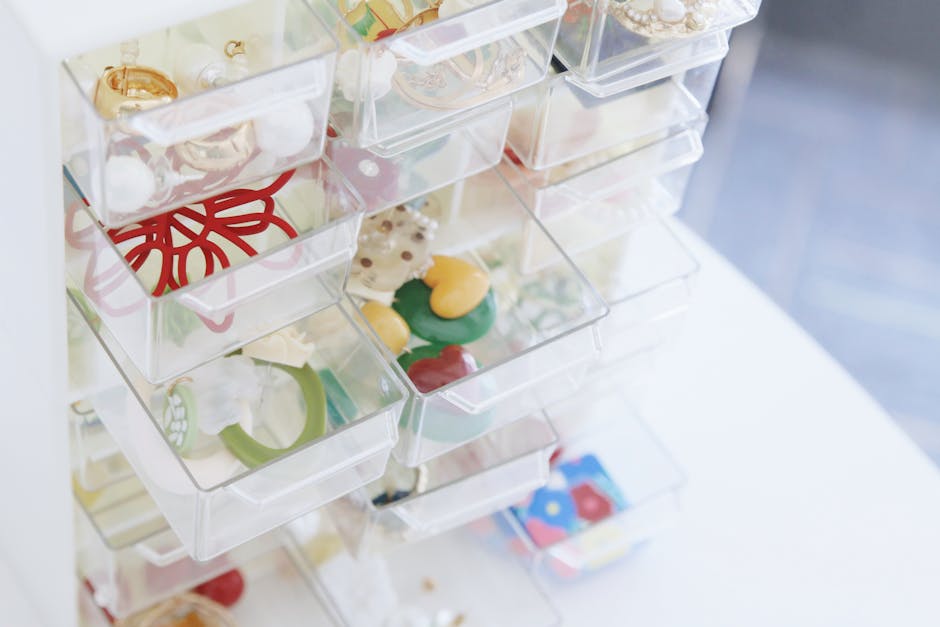
5. Stackable Ring Boxes
Clear acrylic stackable boxes hold rings in individual slots. Stack as collection grows.
Cost: $20 to $40 for a set Best for: Ring collections, drawer storage
6. Magnetic Earring Display
Magnetic strip mounted on the wall. Stud earrings stick directly to the magnet. Saves drawer space.
Cost: $15 to $25 Best for: Stud earring collections
7. Ice Cube Tray for Small Items
A simple silicone ice cube tray (the kind for stick ice) has 12 to 16 compartments perfect for stud earrings and small charms.
Cost: $5 to $10 Best for: Studs, small items, budget option
8. Cup Hooks Inside a Cabinet
Install small cup hooks inside an upper cabinet. Each hook holds one necklace. Cabinet doors close to keep dust out.
Cost: $5 to $10 for hooks Best for: DIY solution, owned homes, hidden organization
9. Egg Crate Foam
Use the bottom of an egg crate (or buy egg crate foam) inside a drawer. Each cup holds one ring or pair of earrings.
Cost: Free or under $5 Best for: Budget solution, drawer storage
10. Travel Roll Organizer
A fabric roll with pockets and pouches for travel. Rolls up to fit in a suitcase.
Cost: $15 to $30 Best for: Travelers, anyone who needs portable organization
What I Wish I Knew About Jewelry Organization
After organizing 4 jewelry collections (my own plus family members), here is what helped.
Audit before organizing. I had 47 necklaces but wore 8. Decluttering first means buying less storage.
Visibility = wear. Jewelry I can see, I wear. Jewelry hidden in boxes goes unworn. Choose storage that displays.
Bedroom location matters. Jewelry near my closet got worn daily. Jewelry on a different floor of the house got worn rarely. Storage near outfits = more use.
Quality over quantity for stands. I bought 3 cheap jewelry stands. They tipped, broke, and tangled. One quality stand outperforms them all.
Different storage for different occasions. I have daily-wear jewelry on a stand, occasional-wear in a drawer, and special-occasion in a closed box. Three tiers based on use.
Organizing By Jewelry Type
Necklaces
The biggest tangle culprit. Solutions:
- Hang each necklace individually (never bundled)
- Use straws for traveling thin chains
- Sort by length on stands
- Keep delicate chains separate from chunky pieces
Earrings
The biggest loss problem. Solutions:
- Always store in pairs (immediate replacement when removed)
- Designated spot for each pair
- Magnetic boards for studs
- Closed boxes for valuable pieces
Rings
Compact but easy to lose. Solutions:
- Ring trays with individual slots
- Vertical ring organizers
- Felt-lined small boxes
- Always store same way (band up, stone up)
Bracelets
Often forgotten. Solutions:
- Bracelet stand or vertical pole
- Drawer organizer with bracelet compartments
- Hooks for chunky bracelets
How Do You Organize a Jewelry Collection by Frequency of Use?
Organize jewelry by frequency of use using a three-tier system. Daily favorites stay on a visible stand or in a top drawer (10 to 15 pieces). Occasional pieces go in a closed drawer organizer (20 to 40 pieces). Special occasion and inherited pieces go in a closed box stored higher in the closet. This system makes daily decisions fast while keeping rarely-used pieces safe.
Setting Up a Jewelry Organization System
Step 1: Empty and Sort (60 min)
Empty every jewelry storage spot. Sort by type:
- Necklaces
- Earrings (pair them up - this is the hardest step)
- Rings
- Bracelets
- Watches
- Brooches/pins
- Anniversary/sentimental pieces
Step 2: Declutter (30-60 min)
For each piece, decide:
- Keep: Worn in past year and still loved
- Donate: Good condition but unworn
- Repair: Worth fixing for active wear
- Toss: Broken beyond repair, costume pieces with damage
Single earrings without a match: hold for 30 days. If the partner is not found, toss or repurpose.
Step 3: Choose Storage by Volume (60 min)
Match storage to your remaining collection size:
- Under 30 pieces: 1 to 2 stands or a drawer insert
- 30 to 100 pieces: Multi-tier solution with stands, drawers, and boxes
- Over 100 pieces: Custom system with multiple zones
Step 4: Set Up Storage (30 min)
Install hooks, place stands, line drawers. Group by type within each storage area.
Step 5: Populate (30 min)
Place each piece in its designated spot. Daily-wear in most accessible spots. Special occasion in farther-back spots.
Caring for Stored Jewelry
Organization is half the work. Care is the other half:
Sterling silver: Anti-tarnish strips in storage areas slow oxidation Gold: Wipe with soft cloth before storing Pearls: Store separately (pearls scratch easily) Costume jewelry: Keep dry; humidity damages Fine jewelry: Annual professional cleaning recommended
For temperature-sensitive items, avoid attics and garages (extreme temperature swings damage).
Travel Jewelry Tips
For travel-friendly organization:
- Pill organizers: Compartments for daily-wear by day
- Sunglass cases: For one or two special pieces
- Travel rolls: For longer trips with more pieces
- Saran wrap: Wrap delicate chains to prevent tangle
Limit travel jewelry to 5 to 10 pieces. More creates organization problems on the road.
For full closet organization, see our walk-in closet guide and small closet ideas.
Common Jewelry Organization Mistakes
After helping family and friends:
Mistake 1: Buying organizers before decluttering. Storage right-sized comes after the audit.
Mistake 2: Mixing types in one container. The tangle returns immediately.
Mistake 3: Storing valuable pieces in visible locations. Bedrooms are first burglary target. Hide valuables.
Mistake 4: Forgetting watches and brooches. They get clutter too.
Mistake 5: Not maintaining the system. Monthly 15-minute reset prevents drift.
Key Takeaway
Jewelry organization is mostly about preventing tangle through separation by type. Necklaces hang individually. Earrings stay paired in compartments. Rings stack in dedicated organizers. Bracelets get their own zone. Match storage to collection size: stands and inserts for under 30 pieces, drawer systems plus stands for 30 to 100 pieces, and full custom zones for larger collections. Daily-wear pieces stay visible to encourage actual wear. Special-occasion pieces go in closed boxes. The audit before organizing matters as much as the organization itself: most people wear 20% of their jewelry. Reduce to favorites and the system becomes manageable. Most jewelry organization projects take a Saturday morning and the results last for years.
For more closet organization, see our walk-in closet guide and shoe organization guide.

Frequently Asked Questions
What is the best way to store jewelry?
The best jewelry storage uses separation by type: necklaces hung individually (prevents tangling), earrings in compartmented trays (paired), rings in stacked organizers, and bracelets on display stands. Avoid throwing everything in one box; the chaos damages chains and wastes time finding pieces.
How do you keep necklaces from tangling?
Prevent necklace tangling by hanging each necklace individually on a hook, stand, or pegboard. Use jewelry boxes with individual necklace slots. For travel, use small zip-lock bags or straws threaded with the chain. The rule: necklaces should never touch each other.
How do you organize earrings without losing them?
Organize earrings using a magnetic board (studs stick directly), compartmented trays (one pair per compartment), or earring stands. Keep pairs together visually. For small studs, use ice cube trays or pill organizers. The key is consistency: every earring has a designated spot.