How to Declutter Clothes: Decisions That Stick
My closet had 412 items in it. I counted because I wanted to know how bad it really was. After the count, I sat on the floor and stared at all that fabric and wondered how it had happened. The clothes did not arrive overnight. They accumulated, sale by sale, gift by gift, “maybe I will wear this” by “maybe I will wear this.”
Decluttering clothes is the hardest decluttering category because clothes are tied to identity, body image, and aspirational futures we have imagined for ourselves. Here is what finally worked.
Why Clothes Are the Hardest Category
Decluttering clothes triggers more emotion than any other category. Here is why:
- Body image: Clothes that no longer fit force us to confront body changes
- Aspirational selves: Clothes for the life we imagined (job we wanted, body we wanted, events we hoped to attend)
- Money guilt: Expensive items feel wasteful to release even when they sit unworn
- Memory: Clothes from significant times in our lives carry emotional weight
- Future scarcity fear: “What if I need this someday?”
A 2019 study from the University of Texas found that emotional attachment is the single biggest barrier to decluttering clothes, far exceeding logistical or financial considerations.
Knowing this matters. You are not weak for struggling. The work is emotional, not just physical.
What Is the Best Way to Declutter Clothes?
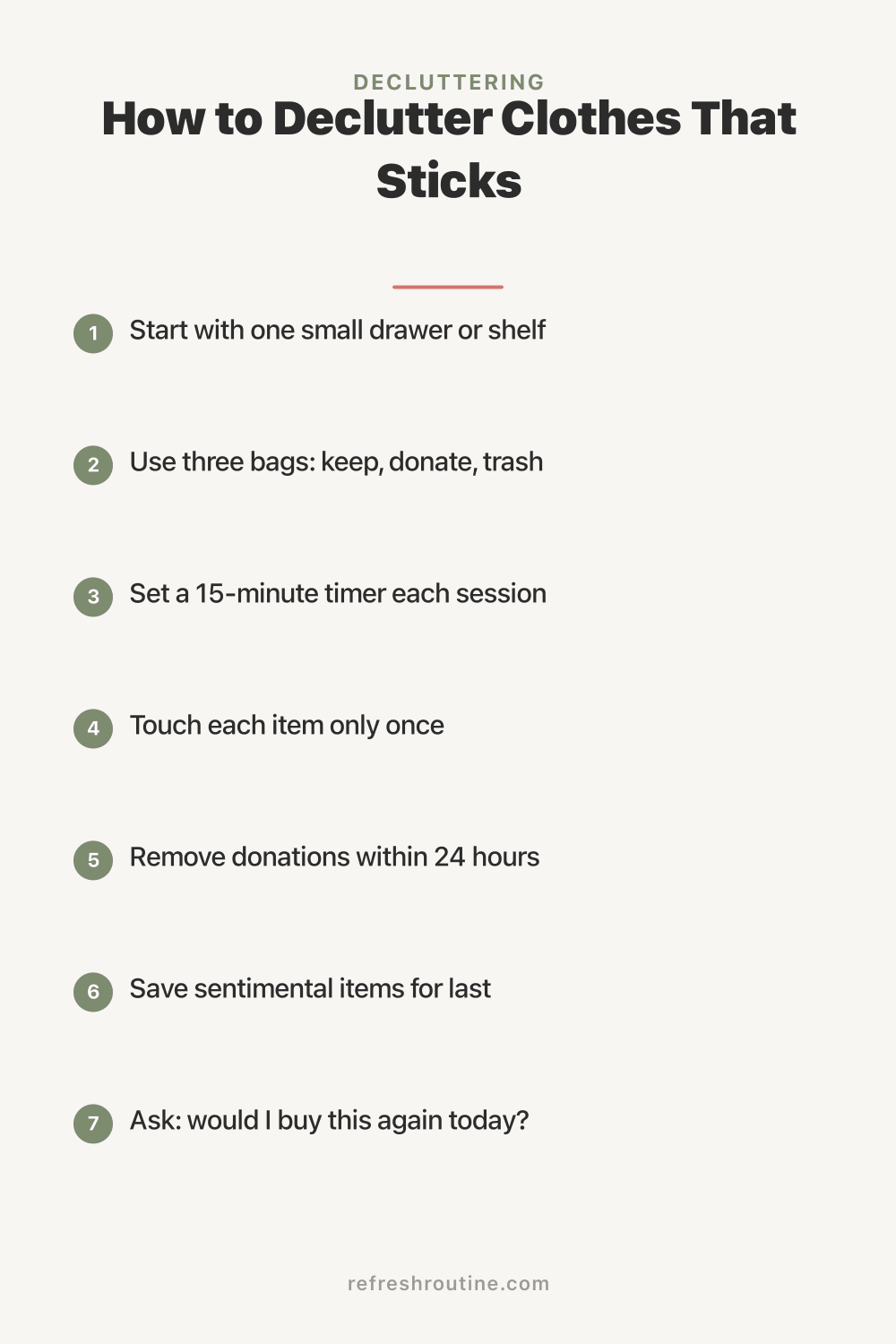
The best way to declutter clothes is to try each item on, ask three questions (does it fit, do I wear it, do I feel good in it), and donate anything that fails. The try-on step is non-negotiable. Most “I will fit into this again” items reveal themselves as no-longer-comfortable once worn. Reserve a 3-hour block for one person’s full wardrobe.
The Try-On Method
The single biggest insight from my many closet purges: you must try things on. Reading clothing tags or holding items up does not give the truth. Trying on does.
Setup (15 minutes)
- Clear your bed completely
- Empty your closet onto the bed
- Pull all drawers and dump on the bed
- Stand in front of a mirror
- Set up three boxes: KEEP, DONATE, MAYBE (one only)
The Try-On Process (2 hours)
For each item:
- Put it on (yes, every item)
- Move around (sit, bend, raise arms)
- Look in the mirror
- Ask the three questions
Question 1: Does it fit?
Right now, today, on the body you have. Not the body you had 5 years ago. Not the body you might have in 6 months. If it does not fit today, donate.
Question 2: Do I wear it?
When did you last wear it? If you cannot remember within 6 months, donate.
Question 3: Do I feel good in it?
Notice your face in the mirror. Are you smiling? Does the fabric feel good? Do you feel like yourself? If no, donate.
If yes to all three, the item is a keeper.
The Maybe Rule
You get one maybe box. Anything in it goes back into the closet for 30 days. If you wear it in those 30 days, keep. If you do not, it goes immediately. No exceptions.
What I Wish I Knew About Clothing Decluttering
After 4 major closet overhauls, here is what made the difference.
Trying on is the only honest method. Mental decisions (“I will wear this”) fail. Physical decisions (“this fits and feels good”) succeed.
Donate sentimental items photographed first. A photo of you in the wedding-attire dress preserves the memory. The dress in the back of the closet does not.
The number does not matter as much as the wear. I do not have a magic number. I have clothes I love and wear. Some weeks that is 12 items. Some weeks 25. The point is rotation, not count.
Quality over quantity, finally. I now own fewer clothes but better made. Per-wear cost is lower. I look more put together because everything fits.
Capsule wardrobe principles work. Limiting choice (around 30 items for 3 months) makes mornings faster and outfits more polished. Not for everyone, but worth trying. See our capsule wardrobe guide for the system.
Categories to Donate Now
Skip the try-on for these obvious removals:
- Clothing for jobs you no longer have (corporate when you work from home, etc.)
- Maternity clothing once you are done having kids
- Wedding attendee dresses (you have one in the back of every closet)
- Costume clothing (Halloween, theme parties)
- Items with stains, holes, or pilling
- Clothes that scratch, itch, or pinch when worn
- “Skinny” clothes from a different time
- Sentimental items you never wear
- Multiples in the same color/style (keep your favorite)
- Bras with broken underwire
- Stretched out underwear and socks
- Wire hangers from the dry cleaner
What to Do With Decluttered Clothes
Donate
- Local women’s shelters need professional clothing
- Goodwill, Salvation Army for general donations
- Church clothing drives
- Buy Nothing groups in your neighborhood
Sell
- Poshmark (designer items, brand names)
- ThredUp (general clothing)
- Facebook Marketplace (local quick sales)
- The RealReal (luxury items)
Recycle
- For damaged textiles, look up local textile recycling
- Many H&M and Levi’s stores accept old clothing for recycling
- Some city programs include textile pickup
Repurpose
- Cut up old t-shirts for cleaning rags
- Donate fabric to local quilters
- Cut into ribbons for craft projects
How Many Clothes Should You Own?
Most adults function well with 30 to 100 total clothing items including shoes and accessories. The exact number depends on lifestyle (active jobs need more sturdy clothing, climate variability requires more layers). What matters more than count is rotation. If you wear less than 20% of your closet weekly, you have too much.
Preventing the Closet From Refilling
After the declutter, prevent rebuild with these habits.
One in, one out: Every new clothing purchase requires an existing item to leave. No exceptions.
30-day waiting period: For items over $50, wait 30 days before buying. Most “I must have this” urges fade.
Seasonal review: At the start of each season, audit what fits and what is missing. Buy intentionally to fill specific gaps.
Shopping bans: Try a 3-month no-clothes-shopping ban annually. The results are revealing.
Subscribe to fewer brand emails: Unsubscribe from any retailer that sends sale notifications. The temptation has to be removed.
For seasonal rotation strategies, see our seasonal clothing rotation guide.
Decluttering by Clothing Type
Tops
Most people own 4 to 6 times more tops than they wear. Limit to 8 to 15 active rotation pieces. Donate anything pilled, stretched, or unworn for a year.
Bottoms
You need fewer than you think. Most people wear 3 to 5 pairs of pants/jeans regularly. Keep what fits today.
Dresses
Easy to keep, hard to wear. Be honest about which dresses you actually wear vs which sit unused for years.
Outerwear
Keep one in each weight class: light, mid-weight, heavy/winter, rain. Most additional jackets are unused.
Shoes
The 5-10 rule: most adults wear 5 to 10 pairs regularly. Donate the rest.
Accessories
Easy to over-collect. Keep only what you have used in the past year.
What If You Are Hesitant to Donate?
If you struggle with letting go:
- Box hesitant items and store them out of sight for 30 days
- If you do not retrieve anything in 30 days, donate the whole box without opening it
- Take photos of sentimental pieces before donating
- Donate to specific causes that matter (women’s shelters, professional development for low-income women)
- Remember: someone else will use and love what you no longer do
For more on sentimental decluttering, see our sentimental items guide.
Key Takeaway
Decluttering clothes works when you try every item on, ask three honest questions (does it fit, do I wear it, do I feel good in it), and donate anything that fails. The try-on method is the only honest method. Mental decisions about clothing routinely fail. Reserve a 3-hour block, empty everything onto the bed, and process systematically. Donate immediately so items do not migrate back. Most people end up with 30 to 50% less clothing and report feeling more put together with what remains. The closet that loves you back is one full of items that fit your current body and life.
For ongoing closet strategy, see our capsule wardrobe guide and seasonal rotation guide.

Frequently Asked Questions
How do you know what clothes to get rid of?
Get rid of clothes that no longer fit, have not been worn in 12 months, are stained or damaged, no longer match your style or lifestyle, you keep for sentimental reasons but never wear, or feel uncomfortable when worn. Trust the body, not the size label. If it makes you feel bad, it goes.
How many clothes should one person own?
Most adults wear 20 to 30% of their wardrobe regularly. A practical minimum is 30 to 50 pieces total (tops, bottoms, dresses, outerwear). A comfortable maximum is 100 pieces. Beyond that, you wear the same items anyway. Capsule wardrobes often use 33 to 40 pieces total.
What is the 1-year rule for clothes?
The 1-year rule says any clothing item not worn in 12 months should be donated or sold. The reasoning: a full cycle of seasons proves you do not need it. Exceptions include special occasion clothing (wedding attire, suits) and items in active rotation that you simply have not worn recently.