How to Build a Capsule Wardrobe and Declutter Your Closet

I used to stand in front of a packed closet every morning and say, “I have nothing to wear.” My closet was bursting with clothes, yet I reached for the same 10 items on repeat. The rest just hung there, taking up space and making me feel guilty.
That frustration is what led me to build a capsule wardrobe. A capsule wardrobe is a small, curated collection of versatile clothing pieces that all mix and match with each other. Instead of owning 150 items and wearing 15, you own 35 items and wear all of them.
Research from the Haultail consumer survey found that the average American has approximately $1,000 to $2,500 worth of unused clothing in their closet at any given time. That stat hit me hard. I was literally storing money I could not use.
What Is a Capsule Wardrobe and Why Does It Work?
A capsule wardrobe is a curated collection of 25 to 40 versatile clothing items that you rotate seasonally. It works because every piece coordinates with multiple other pieces, eliminating the “nothing to wear” problem. The concept was introduced by London boutique owner Susie Faux in the 1970s and popularized by designer Donna Karan’s “Seven Easy Pieces” collection. By limiting choices, you reduce decision fatigue while actually creating more outfit combinations. The EPA’s Sustainable Materials Management program highlights that reducing textile consumption is one of the most effective ways to lower your environmental footprint, which makes a capsule wardrobe a win for both your closet and the planet.
The psychology behind it is solid. A study published in the Journal of Consumer Research found that having fewer, better options leads to higher satisfaction with choices. I noticed this myself within the first week. Getting dressed went from a 15-minute ordeal to a 3-minute process.
Step 1: Audit Everything in Your Closet
Before you build a capsule wardrobe, you need to know what you already own. Pull everything out of your closet. Yes, everything. I know this sounds overwhelming, but it took me about 90 minutes and it was the most eye-opening part of the process.
Lay items on your bed and sort them into these piles:
- Love and wear regularly. These are your “always reach for” pieces
- Like but rarely wear. Ask yourself why. Fit issue? Hard to style?
- Haven’t worn in 6+ months. Be honest about whether you will
- Damaged, stained, or poor fit. These leave your home today
When I did this, I counted 127 items in my closet. I regularly wore 22 of them. That’s 17% of my wardrobe doing 100% of the work. If you need help with this editing process, our guide to getting started with decluttering walks through the mindset shift that makes it easier.
Step 2: Define Your Color Palette
This is where my project management brain got excited. A capsule wardrobe needs a cohesive color palette so every piece works with multiple other pieces.
Here is the formula I recommend:
- Choose 2 to 3 neutral base colors. Black, navy, gray, white, beige, or olive. These are your pants, skirts, and outerwear
- Pick 1 to 2 accent colors. Burgundy, teal, blush, mustard. These add personality to tops and accessories
- Add 1 pattern or print. Stripes, plaid, or a floral that incorporates your chosen colors
My palette is navy, white, and gray with burgundy as my accent. Every single top I own works with every single bottom. That means my 8 tops and 5 bottoms create 40 outfit combinations without even adding layers.
According to the clothing rental service Rent the Runway, women who adopt a capsule approach create an average of 50 to 80 outfit combinations from just 30 to 40 pieces. The math genuinely surprised me.
How Do Capsule Wardrobes Save Money?
Yes, significantly. The average American spends approximately $1,700 per year on clothing according to the Bureau of Labor Statistics. Capsule wardrobe adopters typically reduce that spending by 60 to 75% after the initial investment because every purchase is intentional. Instead of buying 5 cheap tops on impulse, you invest in 2 quality pieces that coordinate with your existing wardrobe. After my first year, I spent $480 on clothing compared to my usual $1,500+. The savings came naturally because the “build the wardrobe” framework eliminated impulse purchases.
Step 3: Choose Your Core Pieces
A solid capsule wardrobe for a typical lifestyle includes:
- 4 to 6 tops. Mix of casual tees, blouses, and layering pieces
- 3 to 4 bottoms. Jeans, trousers, skirts in your base colors
- 2 to 3 dresses. One casual, one that works for events
- 3 to 4 layers. Cardigan, blazer, denim jacket, lightweight sweater
- 2 pairs of shoes. One casual, one dressier
- 2 to 3 accessories. Scarves, belts, or jewelry that elevate basics
Time estimate: Selecting your core pieces takes about 1 to 2 hours once you have completed the audit.
I made the mistake early on of choosing pieces I thought I “should” own rather than pieces that fit my actual life. I’m a work-from-home mom. I don’t need 3 blazers. I need 3 comfortable but put-together tops that work for school pickup and video calls.
Be realistic about your lifestyle. Look at your “love and wear” pile from Step 1. Those pieces tell you exactly what works for your life.
Step 4: Fill the Gaps Intentionally
After sorting your keepers, you will likely have 3 to 7 gaps. Maybe you have plenty of tops but no neutral layering piece. Or you need one good pair of dark jeans.
Make a shopping list. Not a wish list. A specific list that says “one pair of dark wash straight-leg jeans in navy” rather than “new jeans.” This level of specificity prevents you from coming home with three pairs of jeans you didn’t need.
My rules for gap-filling purchases:
- Does it work with at least 3 other items I already own? If not, skip it
- Can I think of 5 specific places I would wear it? Not hypothetical places
- Is the quality good enough to last 2+ years? Cost per wear matters more than sticker price
- Does it fit right now, today? No “when I lose 10 pounds” items
Step 5: Store Off-Season Items Properly
A capsule wardrobe rotates seasonally. Your summer pieces go into storage when fall arrives. This keeps your active closet small and focused. I swap my wardrobe four times a year, and each swap takes about 30 minutes.
For storing off-season clothes, use breathable fabric storage bags or clear bins. Avoid vacuum bags for anything with structure, like blazers or wool coats, because compression can damage fibers over time. Our seasonal clothing rotation guide covers the full swap process and storage methods.
Store bins in the top of your closet, under the bed, or in a hall closet. Label everything. Future you will be grateful.
Does a Minimalist Wardrobe Mean Boring Outfits?
No. A well-built minimalist wardrobe actually creates more outfits than a cluttered closet because every piece works together. The key is choosing pieces with different textures, fits, and necklines within your color palette. A plain white tee looks completely different tucked into high-waisted trousers with a blazer versus paired with jeans and sneakers. Accessories like scarves, statement earrings, and belts add variety without adding bulk. I get more compliments now than when I had four times the clothes.
Maintaining Your Capsule Wardrobe
Building the capsule is the fun part. Maintaining it requires a simple rule: one in, one out. Every time a new piece enters your closet, one piece leaves. No exceptions.
I review my capsule at the start of each season. I check for:
- Wear and damage. Pilling, stretched elastic, faded colors
- Fit changes. Bodies change, and that is normal
- Lifestyle shifts. My needs changed when my youngest started school
- Gaps that appeared. Maybe I wore through my favorite cardigan
This quarterly review takes 20 minutes and keeps the system running smoothly. It pairs perfectly with a broader room-by-room decluttering checklist if you want to extend the capsule mindset to other areas of your home.
What I Wish I Knew Before Building My Capsule Wardrobe
Start with one season, not your entire wardrobe. I tried to do everything at once and got overwhelmed. Pick the current season and build from there.
Your capsule will not be perfect on day one. My first capsule had too many casual pieces and not enough “put-together” options. I adjusted after the first month. Give yourself grace.
Quality basics are worth the investment. I resisted spending $40 on a plain white tee. Then I realized I wear it 3 times a week and it has lasted 18 months without pilling. My $12 fast-fashion versions lasted 3 months each.
Keep a “maybe” bin. Items you are unsure about go in a bin in another room for 30 days. If you do not go looking for them, donate them. I retrieved exactly 2 items out of 15 from my first maybe bin.
Underwear, sleepwear, and workout clothes do not count. These are functional items that exist outside the capsule. Do not stress about including them in your number.
Organizing Your Capsule Closet
Once you have your curated collection, organization becomes simple. With 35 items instead of 120, you can see everything at a glance.
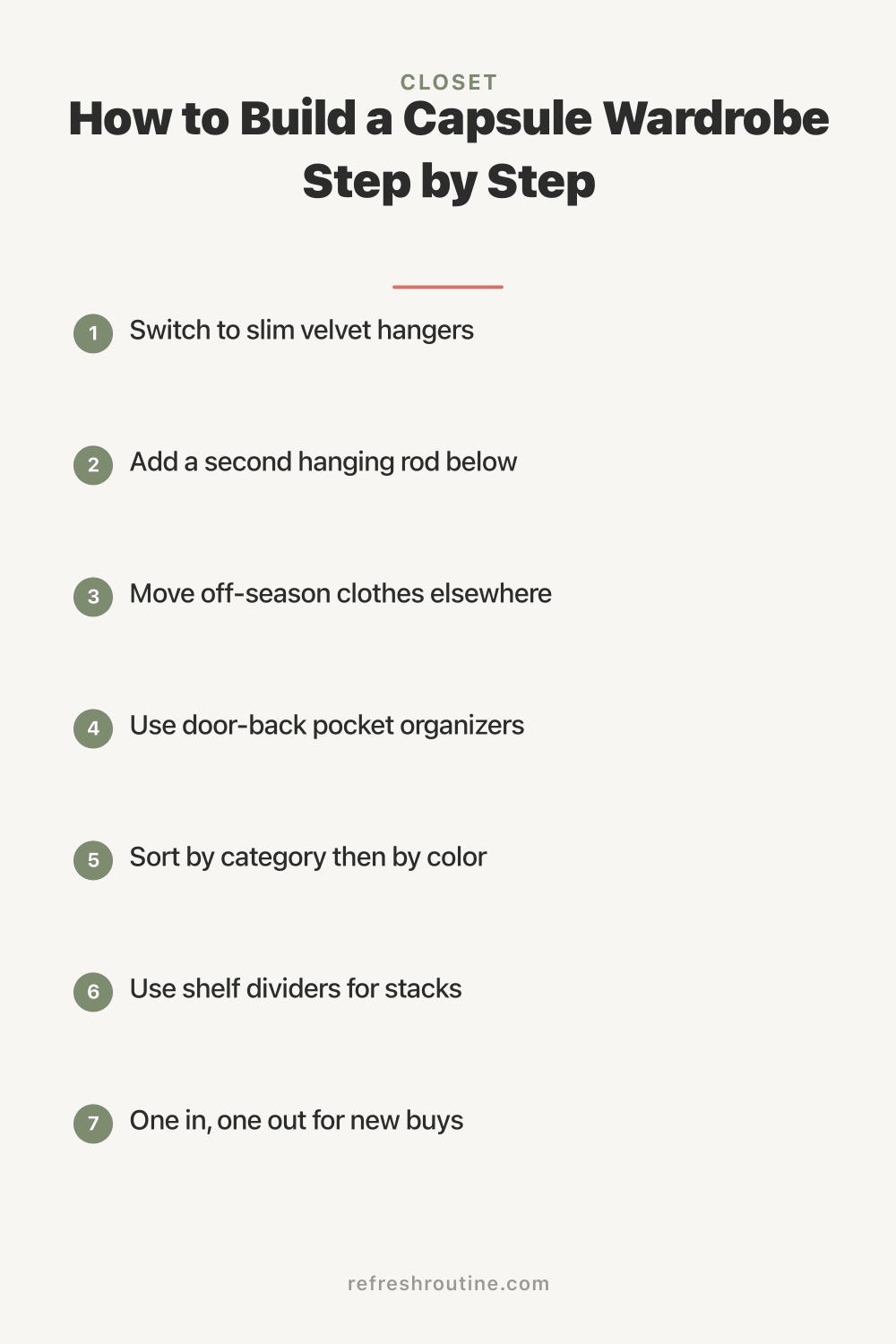
I organize mine by category and then by color within each category. All tops together, lightest to darkest. All bottoms together. Layers on the right side. This system means I can build an outfit in under 3 minutes. Switching to slim hangers and smart storage solutions made my small closet feel twice as large once I had fewer items hanging in it.
Fold heavy knits instead of hanging them. Hanging stretches the shoulders and creates those annoying hanger bumps. I use a single shelf with dividers for my sweaters and cardigans.
Key Takeaway
Building a capsule wardrobe starts with an honest closet audit, a defined color palette, and the discipline to keep only pieces that work with multiple other items. You do not need to buy an entirely new wardrobe. Most people find that 60 to 70% of their capsule already exists in their closet. Start with one season, build a capsule of 25 to 40 pieces, and give yourself a full month before judging the results. The simplicity compounds over time.
Start Your Closet Transformation
A capsule wardrobe is one piece of a fully organized closet. For more closet strategies, visit our complete closet organization hub or check out our daily cleaning routine to bring the same simplicity to the rest of your home.

Frequently Asked Questions
How many items should be in a capsule wardrobe?
A typical capsule wardrobe contains 25 to 40 items, including tops, bottoms, dresses, outerwear, and shoes. The exact number depends on your lifestyle, climate, and work requirements. Start with 35 items and adjust after one full season.
How long does it take to build a capsule wardrobe?
Most people can build their first capsule wardrobe in one weekend. The initial closet edit takes 2 to 3 hours. Filling any gaps with intentional purchases happens over the following 4 to 6 weeks as you identify what is truly missing.
Can a capsule wardrobe work for someone with a business casual dress code?
Absolutely. A capsule wardrobe works especially well for business casual because layering pieces like blazers, neutral trousers, and versatile blouses create dozens of combinations. Focus on a neutral color palette with 2 to 3 accent colors for variety.