Seasonal Clothing Rotation: Storage and Swap System

For years, I crammed all four seasons of clothing into one small closet. Winter coats next to sundresses. Sandals piled on top of snow boots. My closet was so stuffed that I could not see what I actually owned, and I definitely could not find what I needed when the weather changed.
Then I started doing seasonal clothing rotation, and it changed my entire relationship with my closet. A seasonal clothing rotation is a system where you keep only the current season’s clothing in your active closet and store off-season items elsewhere. It sounds like extra work. It is actually less work than fighting a packed closet every single day.
According to ClosetMaid’s annual survey, 47% of Americans say their closets are too full to find what they need. That number drops dramatically when you remove 40 to 60% of the contents and put them in seasonal storage.
Why Does Seasonal Clothing Rotation Work?
Seasonal clothing rotation works because it reduces visual clutter and decision fatigue by limiting your active wardrobe to items appropriate for the current weather. The average American closet contains 103 items, but in any given season, you realistically wear 25 to 40 of them. By storing the remaining 60+ items elsewhere, you can see every option clearly, get dressed faster, and maintain organization easily. The system also creates a built-in wardrobe audit twice a year, which means you naturally identify items to donate or replace before they accumulate into overwhelming clutter.
What You Need Before Your First Swap
Gather these supplies before starting your seasonal clothing rotation:
- 4 to 6 clear storage bins with lids (one per category: heavy sweaters, coats, boots, etc.)
- Breathable garment bags for suits, dresses, or structured items
- Cedar blocks or lavender sachets for moth prevention
- Silica gel packets for moisture absorption
- Labels or painter’s tape for marking bin contents
- One large bag or box for donations
Cost estimate: $40 to $60 for bins, cedar, and garment bags. This is a one-time investment that lasts years.
I made the mistake of using garbage bags my first time. Clothes got wrinkled, I could not see what was inside, and one bag split open in the closet. Invest in clear bins. You will thank yourself every swap day.
Step 1: Pull Everything Out of Your Closet
I know this step feels dramatic, but it is essential. Remove every item from your closet and lay it on your bed. You need to see your full inventory to make good decisions about what stays and what gets stored.
As you pull items out, sort them into three groups:
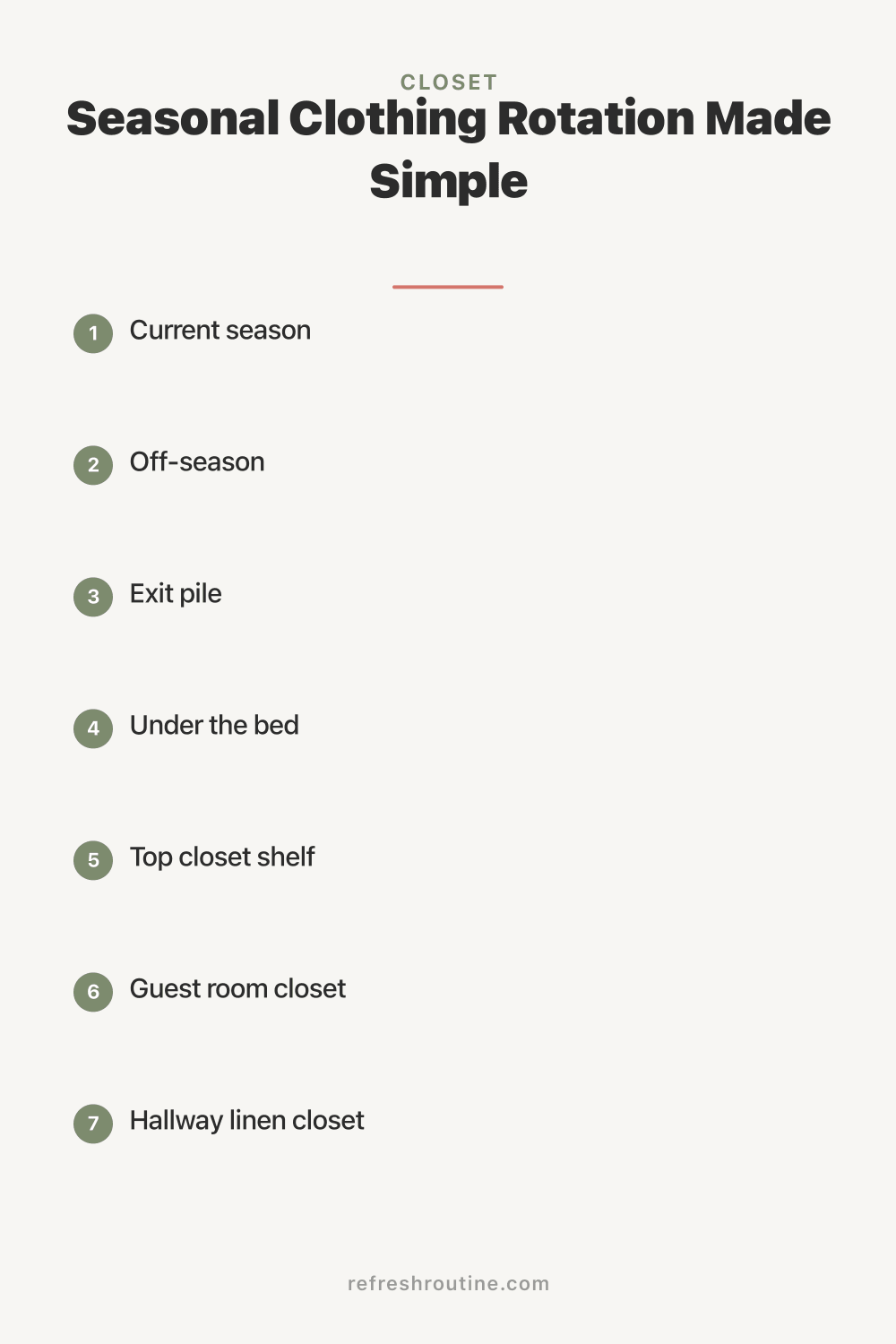
- Current season. Items you will wear in the next 3 months
- Off-season. Items for a different season that you want to keep
- Exit pile. Items to donate, sell, or toss
This is where the seasonal swap becomes a natural decluttering opportunity. Every time I do a swap, I find 5 to 10 items I am ready to release. A sweater I did not reach for all winter. Shorts that are uncomfortably tight. Shoes that gave me blisters every time I wore them.
If the decluttering part feels overwhelming, our guide to starting your decluttering journey can help with the mindset shift.
Step 2: Evaluate Each Off-Season Item Honestly
Before packing anything into storage, ask yourself three questions:
- Did I wear this during its season? If a summer dress sat in your closet all summer, you are unlikely to reach for it next year
- Does it still fit and look good? Bodies and styles change. That is perfectly fine
- Is it in good condition? Stains, pilling, broken zippers, and stretched elastic are all signals to let go
I use the “season test” rule. If an item has survived two full seasonal rotations without being worn, it leaves my house. No exceptions. This rule has helped me reduce my total wardrobe from over 100 items to about 65, and I genuinely wear all of them.
The Environmental Protection Agency reports that the average American generates approximately 82 pounds of textile waste per year. Donating gently used clothing keeps usable items out of landfills and helps others. I drop my donation bag at a local thrift store on swap day so it leaves my house immediately.
Step 3: Clean Before You Store
Never store dirty clothes. Stains set permanently during storage, body oils attract insects, and odors intensify in closed containers.
Before packing off-season items:
- Wash or dry clean everything. Even items that look clean may have invisible oils
- Repair anything that needs it. A loose button is easy to fix now and annoying to discover next season
- Remove dry cleaning bags. Plastic traps moisture and causes yellowing on white fabrics
I learned this the hard way when I stored a “clean” white cardigan that had deodorant residue. After 6 months in a bin, it had permanent yellow staining. Now every item gets washed before storage, no exceptions.
How to Store Seasonal Clothes Properly
Here is my bin-packing system, refined over 4 years of seasonal swaps:
Heavy Knits and Sweaters
Fold (never hang, as hanging stretches knits) and stack in a clear bin. Place a cedar block on top before closing the lid. Cedar naturally repels moths, and according to the University of Kentucky Entomology Department, cedar oil can kill small moth larvae on contact, though it is less effective against larger larvae and adult moths. Supplement cedar with clean storage practices for best results.
Coats and Structured Jackets
Use breathable garment bags, not plastic. Hang them in a spare closet, on a garment rack, or on a sturdy hook in your garage or basement. Avoid folding structured items because creases are difficult to remove after months of storage.
Shoes and Boots
Store in clear bins or their original boxes. Stuff boots with acid-free tissue paper or pool noodle sections to maintain shape. Add a silica gel packet to each container.
Accessories
Scarves, hats, and gloves can share a bin. I use a small bin with compartments (a desk organizer works well) inside a larger storage container to keep accessories separated.
Where to Store Off-Season Clothing
The ideal storage location is cool, dry, and dark. Here are the best options ranked:
- Under the bed. Low-profile bins fit under most bed frames. This is where I store my summer clothes during winter
- Top closet shelf. Labeled bins up high keep off-season items accessible but out of the way
- Guest room closet. If you have one, this is perfect for hanging garment bags
- Hallway linen closet. Dedicate one shelf to seasonal clothing bins
- Climate-controlled attic or basement. Only if the space stays dry and temperature-stable
Avoid: Garages without climate control, damp basements, and outdoor storage sheds. Temperature swings and humidity damage fabrics, encourage mold growth, and attract pests.
I store my off-season clothing under the bed (2 bins) and on the top shelf of my closet (2 bins). Everything fits, and swap day requires no trips to the attic.
Is Seasonal Clothing Rotation Worth the Effort?
Absolutely. Seasonal rotation takes approximately 1 to 2 hours twice a year and saves an estimated 5 to 10 minutes every morning in getting-dressed time. Over a 6-month season, that is 15 to 50 hours saved. Beyond time savings, a reduced closet decreases decision fatigue. A study published in the Journal of Consumer Psychology found that fewer visible options lead to faster, more satisfying decisions. My mornings went from stressful to streamlined once I could see every option in my closet at a glance, without pushing past parkas to reach a t-shirt.
My Seasonal Swap Schedule
I swap my wardrobe four times per year. Here is my schedule:
- Late March (spring swap). Remove heavy coats, wool sweaters, thick scarves, and boots. Bring out light layers, rain jackets, and transitional pieces
- Late May (summer swap). Remove remaining sweaters, long sleeves, and closed-toe shoes not needed. Bring out shorts, tank tops, sandals, and swimwear
- Mid-October (fall swap). Remove shorts, sandals, and summer dresses. Bring out sweaters, boots, and layering pieces
- Early December (winter swap). Remove remaining fall-weight items if needed. Bring out heavy coats, wool accessories, and insulated boots
Each swap takes me 30 to 45 minutes now that I have a system. The first swap took about 2 hours, but it gets faster every time because your bins are already organized from the previous season.
If you are also working on a capsule wardrobe, seasonal rotation is the perfect companion system. A capsule of 30 to 35 items per season means you are only actively managing a fraction of your total wardrobe.
What I Wish I Knew About Seasonal Clothing Rotation
Transition pieces are tricky. Cardigans, light jackets, and layering tanks work across multiple seasons. I keep a small “transition” section in my closet that stays year-round. About 8 items live here permanently.
Do not over-categorize. My first system had separate bins for “spring light knits,” “spring bottoms,” and “spring tops.” That was too many bins. Now I use “warm weather” and “cold weather” as my only two categories, with a transition section.
Swap day is donation day. Making it a combined event ensures outgoing items actually leave the house. I keep a donation bag next to my swap bins, and anything I pulled but do not want goes straight in. No second-guessing.
Take a photo of your off-season bins. I snap a photo of each bin’s contents before closing the lid. When I need something out of season (a wedding in January that requires a summer dress), I check the photo instead of opening every bin.
Weather does not follow the calendar. I used to swap based on date, but now I watch the 10-day forecast. If temperatures are still hitting 80°F in October, I wait. Swapping too early means pulling items back out, which defeats the purpose.
Maintaining the System Year-Round
Between swaps, maintain your active closet with these habits:
- Return items to their spot after laundry. Do not just pile them on the chair
- One in, one out. New purchase? Something leaves. Our small closet ideas guide covers more strategies for keeping a streamlined closet
- Weekly 2-minute scan. Glance at your closet once a week. Anything out of place? Fix it in the moment
- Note items you never reach for. Mental note during the season means easy editing on swap day
Your closet is not the only space that benefits from regular maintenance. A daily cleaning routine applies the same principle across your entire home. Small daily actions prevent the big overwhelming cleanups.
Key Takeaway
A seasonal clothing rotation keeps your active closet lean by storing off-season items in labeled bins elsewhere. The system requires about 1 to 2 hours twice a year and creates a built-in opportunity to declutter with every swap. Start by pulling everything out, sorting by season, cleaning before storing, and choosing a cool, dry storage location. After two or three cycles, the process becomes second nature and your daily relationship with your closet transforms completely.
Build Your Complete Closet System
Seasonal rotation works even better as part of a full closet strategy. Visit our closet organization hub for more methods, or explore our laundry organization tips to keep your freshly rotated wardrobe clean and maintained all season long.

Frequently Asked Questions
When should you swap seasonal clothes?
Swap seasonal clothes when the temperature consistently stays above 65°F (spring) or below 55°F (fall) for two weeks. For most US climates, this means late March to early April for the spring swap and mid-October for the fall swap.
How do you store winter clothes in the summer?
Store winter clothes in breathable fabric bags or clear plastic bins in a cool, dry location. Add cedar blocks for moth protection and silica gel packets for moisture control. Avoid vacuum bags for wool and structured items as compression can damage fibers.
What should you do with clothes you find during a seasonal swap that no longer fit?
Donate items that no longer fit during each seasonal swap rather than storing them for another season. If you did not wear an item during its entire season, it likely will not get worn next year either. Set a donation bag next to your swap bins.