Holiday Decluttering: Before, During, and After the Season

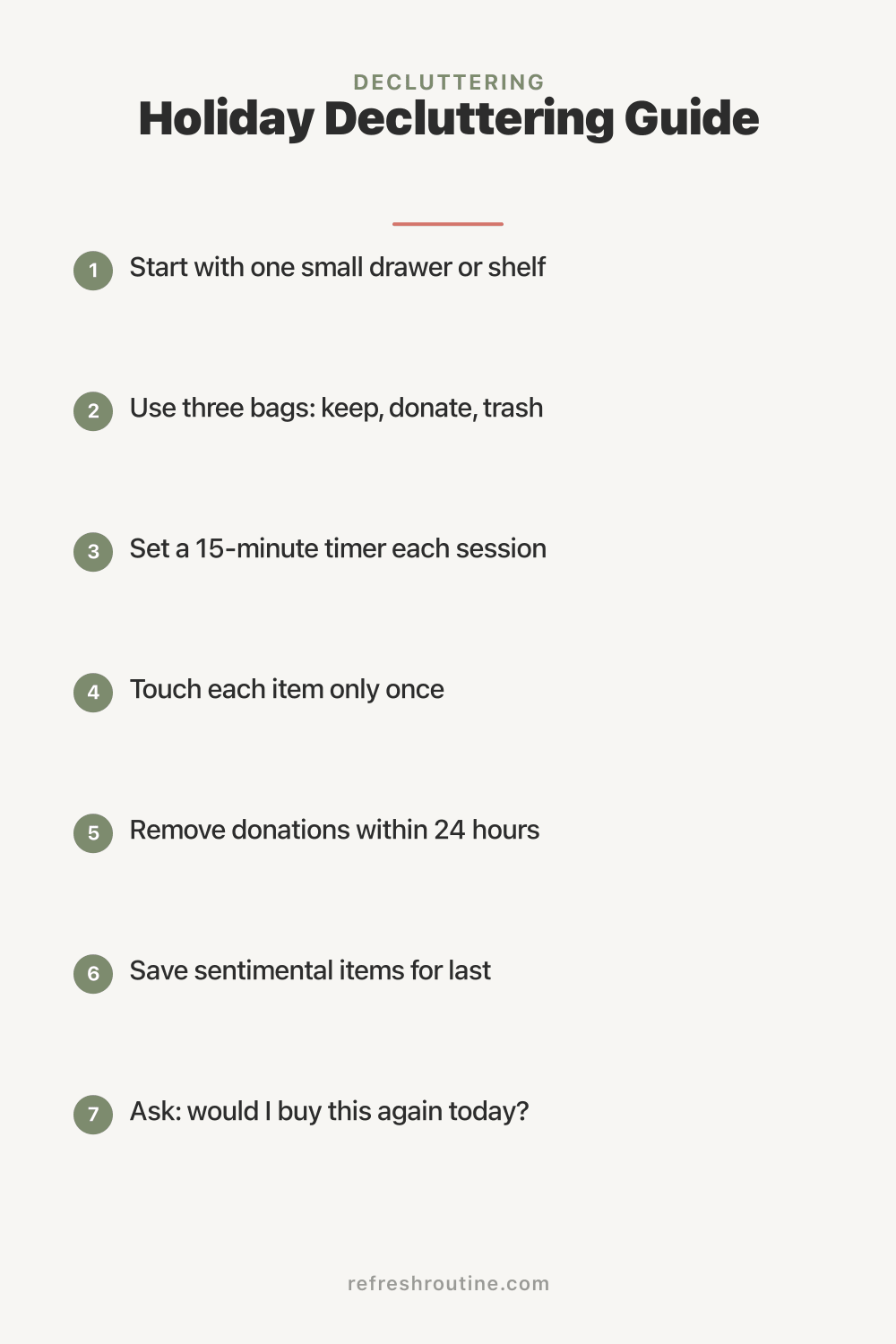
Three years ago our family Christmas resulted in 8 new toys for the kids, 3 cookware items I did not need, and 7 candle gifts from coworkers. By January 15, half of it lived in awkward “not yet put away” piles around the house. By February, our basement was overflowing.
The fix was not to refuse gifts. The fix was to manage the inflow strategically: decluttering before, during, and after the holiday. Here is the complete system.
Why Holidays Create Clutter
Holidays compound clutter through:
- High-volume gift exchange: 5 to 10 items per person on average
- Decoration accumulation: Each year adds rather than replaces
- Hosting supplies: Holiday-specific items used once a year
- Food storage: Bulk shopping and leftover containers
- Wrapping materials: Boxes, paper, gift bags multiply
- Sentimental attachment: Gifts from loved ones feel obligatory to keep
According to research from Stuffocation by James Wallman, the average American household has 30% more items in January than in October. Without decluttering, this accumulates year after year.
What Is the Best Holiday Decluttering Strategy?
The best holiday decluttering strategy works in three phases: before (4 to 6 weeks before, decluttering categories that will receive gifts), during (managing inflow strategically), and after (post-holiday reset within 2 weeks). The three phases prevent the accumulation cycle that traps most families. Each phase takes 2 to 4 hours.
Phase 1: Pre-Holiday Decluttering (4-6 Weeks Before)
Week 1: Set Gift Expectations
Talk to family about gift exchanges before they shop:
For kids’ gifts: Suggest specific categories (books, art supplies, experiences) instead of leaving open-ended
For adult gifts: Suggest consumables (food, candles, wine), experiences (concerts, classes), or specific needs
For exchange events: Consider a no-gift agreement or modest spending limit
For host gifts: Coordinate to avoid duplicates
These conversations feel awkward but save mountains of clutter.
Week 2: Declutter Categories That Receive Gifts
The categories most likely to receive gifts deserve pre-declutter:
Kids’ toys: Remove old/outgrown items. Make room for new. See our decluttering kids’ toys guide.
Kitchen items: Donate duplicate gadgets and unused tools. Most home cooks gift kitchen items.
Hobby supplies: Clear out craft supplies, sports gear, books that are not used.
Beauty products: Toss expired makeup. Donate unopened items.
Clothing: Reduce to make room for gift items.
Week 3: Decor Decluttering
Pull out your holiday decor. Sort:
Keep: Pieces you display and love Donate: Good condition but no longer used (2+ years unused) Repair: Broken but worth fixing Toss: Beyond repair
Most homes own 2 to 3x more holiday decor than they actually display. Reduce.
Week 4: Space Preparation
- Clear flat surfaces (where gifts and decor will land)
- Organize closets where new items will go
- Set up a “donate after holidays” bin in the basement or garage
- Photograph spaces before holiday transformation
Phase 2: During-Holiday Management
The holidays themselves require active management:
Gift Receiving Strategy
When unwrapping:
- Open gift, appreciate, take photo if sentimental
- Decide immediately: love and use OR donate
- Items destined for donation go directly in the donate bin
- Avoid the “I will deal with it later” pile
Hosting and Visiting
- Use disposable serveware for large gatherings
- Limit decoration to current year’s favorites (not all you own)
- Keep gift wrap and bags only if you reuse them
- Take photos of holiday tablescapes instead of saving them
Wrapping Materials
- Recycle paper immediately after opening
- Save only quality gift bags (5 to 10 maximum)
- Donate extras
- Boxes get flattened and recycled or saved (1 to 2 only)
Phase 3: Post-Holiday Reset (First 2 Weeks of January)
The most important phase. Done well, prevents accumulation.
Week 1 of January: Gift Processing
For each new gift received:
Love and will use: Find permanent home immediately Like but already have similar: Choose your favorite; donate the duplicate Do not love: Donate immediately while still in original packaging if possible Sentimental but unusable: Photograph the gift with note about who gave it, then donate the physical item
The key: process every gift within 7 days. Items in limbo become permanent clutter.
Week 2 of January: Decoration Storage
Pack away holiday decor with intention:
- Clean each item before storing
- Use labeled bins (Christmas, Halloween, etc.)
- Bubble wrap or tissue paper for breakables
- Photograph contents of each bin
- Note repairs needed for next year
- Donate decor decided to release
Week 3: Pantry and Kitchen Reset
After holiday cooking:
- Use up perishables
- Donate excess canned goods to food bank
- Reset pantry organization
- Eliminate duplicate spices and supplies
For pantry strategies, see our pantry organization guide.
Week 4: Final Audit
Walk through the house. Look for:
- Items still not put away (find homes or donate)
- New duplicate spots created
- Wrapping materials still around
- Cards to recycle (keep favorites)
- Food still in fridge to use or toss
What I Wish I Knew About Holiday Decluttering
After 5 years of refining this system, here is what helped most.
The pre-holiday talk works. I dreaded asking family to limit gifts. The actual conversations were appreciated. Most people prefer giving meaningful gifts, not adding to clutter.
Experience gifts are the answer. Concert tickets, classes, museum memberships create memories without clutter. Now suggested to all our gift-givers.
The donation bin in the basement is non-negotiable. Items not loved go straight to the bin. By February, the bin gets dropped off. No mid-year reconsideration.
Photographs of sentimental items make releasing easier. Kid art, holiday cards, special tablescapes all live in photos now, not boxes.
One year’s decor at a time. Each Halloween or Christmas, I use only current year’s items. Anything unused two years running gets donated.
Specific Holidays Have Different Needs
Christmas
Highest gift volume of any holiday. Pre-declutter is critical. Decor accumulation also peaks. December 26 starts the reset.
Hanukkah
Lower decor accumulation. Gifts spread over 8 days mean smaller daily inflow. Pre-declutter still helpful for gift categories.
Easter
Less gift exchange but kid baskets accumulate candy and small toys. Easter Monday is reset day.
Halloween
Costumes and candy. Costumes need decluttering after each season; candy gets used quickly.
Thanksgiving
Less gift exchange. Focus is on hosting supplies and food management.
Birthdays (Mini-Holidays)
Apply the same 3-phase system in miniature. Pre-birthday decluttering of the celebrant’s items. Post-birthday processing within a week.
How Do You Reduce Holiday Decor?
Reduce holiday decor by displaying only what you love and use this year, not everything you own. Each season, audit: did you actually display this? Did you smile when you saw it? Anything unused for 2 consecutive years should be donated. Most homes can reduce holiday decor by 40 to 60% without losing any pieces that matter. Focus on signature decorations (your tree, your nativity, your menorah) rather than complete sets.
Setting Gift Expectations
The conversation that prevents most clutter:
For close family: “We are simplifying this year. Could you focus on experiences or consumables instead of things?”
For extended family: “The kids have plenty of toys. Books or art supplies would be wonderful.”
For coworkers: “Optional gift exchange this year or a budget cap of $X.”
For neighbors: “Cookies or homemade items mean more to us than store-bought.”
Be specific. Vague “I don’t need anything” leaves the gift-giver guessing.
Gift-Giving Ourselves
When you are the gift-giver, model the values:
Experiences over things: Concerts, classes, vacations Consumables: Wine, special foods, candles Donations in name: Charity contributions Books: Always welcome, easy to declutter later Subscriptions: Magazines, services, classes Quality essentials: One nicer everyday item instead of multiple cheap ones
The gifts you give influence the gifts you receive.
Holiday Wrapping Strategy
Reduce wrapping clutter:
Choose quality: Few high-quality bags reused for years Skip new wrap each year: Saved bags and tissue paper Use natural materials: Brown paper with twine Cloth gift bags: Reusable, classy Or no wrap: Some experience gifts need no packaging
Each $5 saved on wrap = $50 in 10 years.
Post-Holiday Donation Strategy
Plan donations in advance:
January donation drive: Most thrift stores have inventory shortages after holidays. Your timing helps.
Toys for school programs: Donate gently used kid items to schools or shelters
Cookware to women’s shelters: Often understocked
Books to libraries: Always welcome
Holiday decor to Buy Nothing groups: Neighbors love quality items
Process donations within 30 days of holiday for tax purposes.
For more strategies, see our decluttering for downsizing guide and decluttering mistakes.
Family Communication
Holidays are sensitive. Strategies that work:
Lead with appreciation: “We love that you think of us. Could we suggest…”
Frame as values: “We are focused on experiences this year”
Provide alternatives: “Here are some specific things we would love”
Respect choices: Some family members will continue traditional gift-giving. Accept gracefully and process strategically.
Long game: Build new norms over years, not all at once
Common Holiday Decluttering Mistakes
After teaching this system:
Mistake 1: Decluttering AFTER holidays only. Pre-decluttering matters more.
Mistake 2: Refusing gifts. Creates family tension. Better to receive and process strategically.
Mistake 3: Storing everything “just in case.” Two-year rule for decor.
Mistake 4: Avoiding the gift conversation. Specifying preferences helps everyone.
Mistake 5: Not setting a donation deadline. Indefinite donation piles become clutter.
Building a Holiday Decluttering Habit
Year 1: Implement basic system Year 2: Refine based on what worked Year 3: System feels automatic Year 4+: Holiday clutter is no longer a problem
Most families see significant improvement in the second year and dramatic improvement by year three.
Key Takeaway
Holiday decluttering works in three phases: pre-holiday (4 to 6 weeks before, decluttering gift-receiving categories and setting expectations with family), during-holiday (active management of inflow), and post-holiday (within 2 weeks, processing gifts and resetting spaces). Each phase takes 2 to 4 hours and prevents the year-over-year accumulation that overwhelms most families. The hardest part is the family conversation about gifts; the easiest part is the post-holiday donation drop-off. Implement this year and see results before the next holiday cycle. The compounded effect over 3 to 5 years is dramatic: most families eliminate post-holiday overwhelm entirely while maintaining meaningful traditions.
For more, see our decluttering kids’ toys and sentimental items guides.

Frequently Asked Questions
When should you declutter before the holidays?
Declutter before the holidays starting 4 to 6 weeks before the gift-giving date. November 1 for Christmas; October 1 for Hanukkah preparation. This creates space for incoming gifts without panic. Focus on the categories that will receive gifts: toys for kids, kitchen items, hobby supplies, decor.
What should you do with old holiday decorations?
Sort old holiday decorations into keep (love and use), donate (good condition but unused for 2+ years), repair (worth fixing), and toss (broken beyond repair). Most homes own 2 to 3x the holiday decor they actually display. Reduce to your current taste and seasonal preferences.
How do you prevent holiday clutter from accumulating?
Prevent holiday clutter by setting gift expectations with family (experiences over things, books, contributions to college funds), implementing one-in-one-out for new toys and decor, and donating duplicates during the wrap-up. Strategic communication before the holidays reduces 50% of post-holiday clutter.