How to Clean Your House When You Feel Overwhelmed

Last spring, I stood in my kitchen doorway and cried. Not because anything terrible had happened. Just because the dishes had piled up for four days, the laundry was overflowing onto the hallway floor, and every single counter was covered in stuff. I felt completely paralyzed. I knew I needed to clean, but I had no idea where to start. So I did nothing. Again.
If you’ve ever felt overwhelmed by a messy house, I want you to know two things. First, you are not lazy. Second, there is a way out that doesn’t require motivation, energy, or an entire free weekend. I’m going to walk you through the exact method I used to go from frozen to functional. It starts with five minutes and one trash bag.
Does a Messy House Actually Affect Your Mental Health?
Yes. Research from UCLA’s Center on Everyday Lives and Families found that women who described their homes as “cluttered” or full of “unfinished projects” had higher cortisol levels throughout the day compared to women who described their homes as “restful.” Elevated cortisol is associated with increased stress, poorer sleep, and lower overall well-being. The mess is not just an eyesore. It is actively working against your mental health.
A study published in the Personality and Social Psychology Bulletin also found that people with cluttered homes were more likely to be fatigued and depressed by evening. So if you feel exhausted just looking at the mess, your body is responding exactly as research would predict. The National Institutes of Health recognizes the connection between environment and emotional well-being, noting that a calm physical space supports better mental health outcomes.
The 5-Minute Trash Sweep (Start Here)
When you’re overwhelmed, you don’t need a plan. You need movement. The first step is absurdly small on purpose.
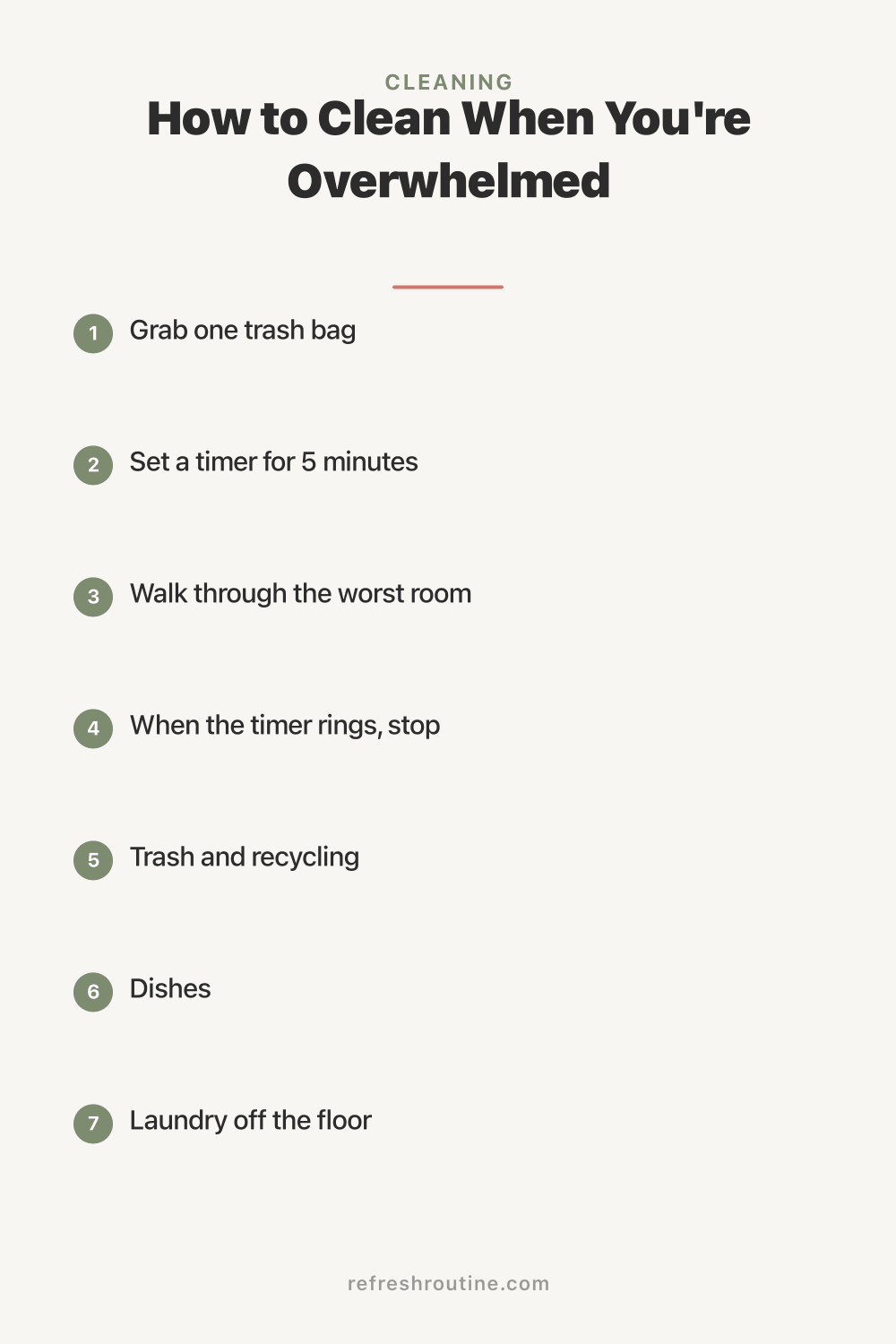
- Grab one trash bag (or a grocery bag, a box, anything)
- Set a timer for 5 minutes
- Walk through the worst room and pick up only trash. Nothing else. Wrappers, junk mail, empty containers, broken items, tissues, packaging
- When the timer rings, stop. Tie the bag and throw it away
That’s it. You’re done with step one.
I know it sounds too simple. But here’s why it works: the hardest part of cleaning when overwhelmed is starting. Your brain is stuck in a decision loop, trying to process every single thing that needs to happen. The trash sweep removes the decision entirely. You don’t have to decide where something goes or whether to keep it. Trash is trash. Pick it up and throw it away.
After my 5-minute trash sweep last spring, I pulled out two full bags from just the kitchen and living room. The rooms didn’t look clean, but they looked noticeably better. More importantly, I felt a tiny spark of momentum. That spark is everything.
The One-Room Reset Method
Once you’ve done the trash sweep, you’re ready for the next phase. I call this the One-Room Reset, and it’s the method I’ve used every time overwhelm hits.
Step 1: Choose the Most Visible Room
Pick the room you see first when you walk through your front door. For most people, that’s the living room or entryway. Do not start with the room that’s the messiest. Start with the room that gives you the most visual relief.
Step 2: Clear All Flat Surfaces
Go to every flat surface in that room. The coffee table, side tables, counters, the dining table. Pick up everything that doesn’t belong and put it in a laundry basket. Don’t sort it. Don’t put things away in their proper places. Just clear the surfaces.
Step 3: Do a Quick Floor Pass
Pick up anything on the floor that doesn’t belong there. Shoes, toys, clothing, bags. Into the laundry basket they go. Then do a quick sweep or vacuum. The floor doesn’t need to be spotless. It just needs to be clear.
Step 4: Fluff and Straighten
Straighten couch cushions, fold throw blankets, align chairs with the table. These tiny adjustments take 2 minutes and make the room look surprisingly put together.
Step 5: Deal With the Basket Later
That laundry basket full of misplaced items? It can sit in a corner for now. You’ll sort it when you have energy. For the moment, you have one fully reset room, and that room is going to be your sanctuary.
Time estimate: 15 to 25 minutes for a standard living room.
When I did my first One-Room Reset, I chose the living room. Within 20 minutes, I had one space in my house that didn’t stress me out. I sat on the couch in my clean room and drank coffee. That break gave me the energy to reset the kitchen next. Then the bathroom. I didn’t clean the whole house that day. I cleaned three rooms over two days, and it was enough.
How Do You Clean When You Have No Energy?
Scale down instead of giving up entirely. The minimum effective cleaning session is 5 to 10 minutes focused on one surface or one category of mess. Wash just the dishes in the sink, not the pots. Clear just the table, not the whole room. The American Cleaning Institute notes that small, consistent cleaning sessions are more effective than occasional deep cleans. Even 5 minutes prevents the mess from growing.
The Priority Cleaning Order
When the whole house feels like a disaster, cleaning in the right order makes a massive difference. Here is the order I follow, based on what creates the most immediate relief.
- Trash and recycling (removes volume fast, no decisions needed)
- Dishes (a clean sink changes the entire feel of a kitchen)
- Laundry off the floor (into baskets or the machine, not folded yet)
- Flat surfaces (tables, counters, desks)
- Floors (sweep or vacuum high-traffic areas only)
- Bathrooms (quick wipe of counter and toilet)
You do not need to do all six in one session. Do one or two. Come back tomorrow for the next one or two. According to the Bureau of Labor Statistics, the average American spends about 1.1 hours per day on household activities. If you can carve out even 20 focused minutes, you can tackle two items on this list.
Breaking the Overwhelm Cycle for Good
Getting the house clean once is step one. Keeping it from spiraling back is step two. Here’s the system that keeps me from ending up in the doorway-crying situation again.
Build a daily maintenance habit. My daily cleaning routine takes 15 minutes and covers the kitchen, surfaces, and one bathroom. It prevents messes from building to overwhelming levels. The key is consistency, not perfection.
Layer on a weekly schedule. Once the daily habit sticks (give it two to three weeks), add a weekly cleaning schedule that assigns one focus area per day. Monday is bathrooms, Tuesday is kitchen deep clean, and so on. Spreading tasks across the week means you never face a mountain of cleaning again.
Declutter the excess. Cleaning is exponentially harder when you have too much stuff. The average American home contains over 300,000 items (LA Times). If every surface collects clutter because there’s no place to put things, the problem isn’t cleaning. It’s volume. Our where to start decluttering guide walks you through reducing the load room by room.
Lower your standards temporarily. This was the hardest lesson for me. When you’re in overwhelm recovery, “clean enough” is the goal. Not magazine-clean. Not guest-ready. Just clear surfaces, clean dishes, and passable floors. You can raise the bar later once the daily habit is running on autopilot.
What I Wish I Knew Before I Hit Rock Bottom
The mess didn’t happen overnight, and it won’t be fixed overnight. I used to set a goal of cleaning the entire house in one day. That expectation guaranteed failure and shame. Give yourself a week to do a full reset, one room per day. It is more realistic and far less exhausting.
Asking for help is not weakness. I called my sister and said, “I need you to come sit with me while I clean the kitchen.” She didn’t clean a thing. She sat at the table and talked to me while I worked. Having another person in the room broke the paralysis. Don’t be afraid to ask.
Clutter and cleaning are two different problems. I spent weeks “cleaning” rooms that were actually just cluttered. No amount of scrubbing fixes a room full of things that don’t have a home. If you can’t put things away because there’s no space, pause cleaning and start decluttering first.
Shame makes it worse. Every article that said “just clean your house, it’s not that hard” made me feel like a failure. If cleaning were easy, nobody would be Googling “overwhelmed by messy house” at midnight. Your struggle is valid. Start with the trash bag. Five minutes. That’s all.
Your worst day still counts. On my worst days, I clean for 5 minutes. Sometimes I just wash three dishes and wipe one counter. It doesn’t look like much, but it keeps the habit alive and prevents backslide. A 5-minute session beats zero every single time.
Key Takeaway
When you’re overwhelmed by a messy house, the solution is not more motivation. It is smaller steps. Start with a 5-minute trash sweep, then reset one room at a time using the clear-surfaces-first method. Build a daily cleaning routine once the crisis passes to prevent future overwhelm. You don’t need to clean the whole house today. You just need to start with one trash bag and five minutes.
Your First Step Starts Now
Grab a bag. Set a timer for 5 minutes. Walk through the worst room and pick up only trash. That’s it. Don’t think about the rest of the house. Don’t plan. Just move.
Once that timer goes off, you’ll have a bag of trash, a slightly better room, and proof that you can do this. Tomorrow, try the One-Room Reset. By the end of the week, your home will feel like a completely different place. For more strategies on maintaining momentum, visit our cleaning hub for routines and schedules that keep the overwhelm from coming back.

Frequently Asked Questions
Where should I start cleaning when my whole house is a mess?
Start with the room you see first when you walk through your front door. Visible progress in that space creates immediate relief and momentum. Focus on clearing flat surfaces and removing trash first. Do not try to organize or deep clean. Just clear and reset one room at a time.
Why do I feel so overwhelmed by cleaning?
Overwhelm happens when your brain perceives the total workload as one giant task instead of many small ones. Clutter also raises cortisol levels, creating a stress cycle where the mess causes anxiety and anxiety prevents you from cleaning. Breaking tasks into tiny steps interrupts this loop.
How do I keep my house clean after catching up?
Build a simple daily maintenance routine of 15 minutes covering kitchen, surfaces, and one bathroom. Pair it with a weekly schedule that assigns one focus area per day. Maintenance prevents the mess from snowballing back to overwhelming levels.