Stain Removal Guide: Cheat Sheet for Every Fabric

I have two kids, a clumsy husband (his words, not mine), and a talent for spilling coffee on myself before 8 AM. Stain removal is not a hobby for me. It’s a survival skill. Over the years, I’ve tried every product, hack, and old wives’ tale out there. Some work brilliantly. Some made things worse. And one ruined my favorite white blouse permanently.
This stain removal guide is the cheat sheet I wish I’d had from the start. It covers the most common household stains, the right treatment for each one, and the critical mistakes that set stains permanently. I keep a printed version taped inside my laundry room cabinet, and I reference it at least twice a week.
The American Cleaning Institute reports that the average American family deals with about 3 to 4 stain incidents per week. That’s over 150 stains per year. Having a quick-reference system saves both clothes and money.
The Golden Rules of Stain Removal
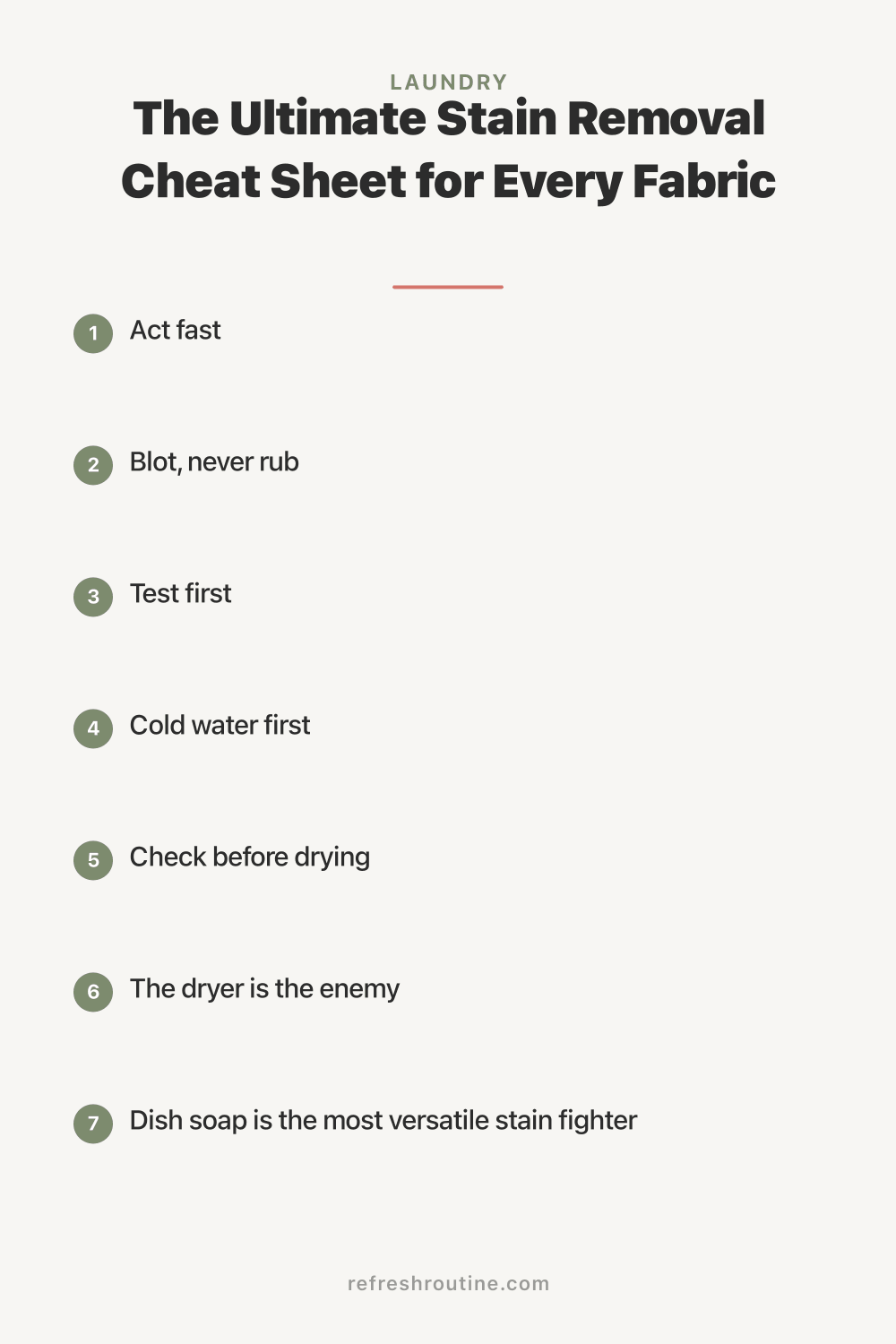
Before diving into specific stains, these rules apply to every stain treatment. I learned each one through trial and error (mostly error).
- Act fast. Fresh stains are dramatically easier to remove than set stains. Even blotting with cold water immediately after a spill makes a difference.
- Blot, never rub. Rubbing pushes the stain deeper into fabric fibers and spreads it outward. Press a clean cloth against the stain to absorb the substance.
- Test first. Apply any treatment to an inconspicuous area (inside seam, hem) before treating the visible stain. I ruined a silk scarf by applying hydrogen peroxide without testing.
- Cold water first. Unless the stain is grease-based, start with cold water. Hot water sets protein stains (blood, milk, egg) permanently.
- Check before drying. Never put a stained garment in the dryer. The heat sets the stain, making it nearly impossible to remove. Air dry treated items and check the stain before machine drying.
What Is the Best All-Purpose Stain Remover?
A mixture of one tablespoon of dish soap and two tablespoons of hydrogen peroxide is the most effective all-purpose stain remover for most fabrics. This combination breaks down both grease-based and organic stains. Apply directly to the stain, let it sit for 10 to 15 minutes, then launder normally. According to textile care research from North Carolina State University, enzymatic treatments and oxidizing agents like hydrogen peroxide are the most effective at breaking molecular bonds in common stains without damaging fabric.
I keep a small spray bottle of this mixture in my laundry room at all times. It handles about 80% of the stains my family creates.
Food and Beverage Stains
Coffee and Tea Stains
Treatment:
- Rinse immediately with cold water from the back of the stain (push the stain out, not in)
- Apply white vinegar directly to the stain
- Let sit 5 to 10 minutes
- Rub a small amount of liquid dish soap into the stain
- Rinse with cold water and wash normally
What I learned: Coffee stains that have dried respond better to a baking soda paste (baking soda plus water, let sit 30 minutes) followed by vinegar.
Red Wine Stains
Treatment:
- Blot excess wine immediately
- Cover the stain with table salt to absorb the liquid
- After 5 minutes, brush off the salt
- Pour boiling water over the stain from about 12 inches above (the height and heat help flush the stain)
- Apply hydrogen peroxide and dish soap mixture
- Wash on the warmest setting safe for the fabric
What I learned: Club soda works as a first response when you don’t have other supplies handy. I keep a small bottle in the kitchen for exactly this reason.
Grease and Oil Stains
Treatment:
- Sprinkle cornstarch or baking soda on the stain to absorb excess oil
- Let sit 15 to 20 minutes
- Brush off the powder
- Apply dish soap directly to the stain (dish soap is designed to cut grease)
- Work it in gently with your fingers
- Wash in the warmest water safe for the fabric
What I learned: For old or set grease stains, WD-40 actually works. Spray it on the stain, let sit 15 minutes, then treat with dish soap before washing. It sounds counterintuitive, but the solvent in WD-40 dissolves the old grease so the soap can lift it out.
Tomato Sauce and Ketchup
Treatment:
- Scrape off excess sauce with a spoon (don’t rub)
- Rinse with cold water from the back of the fabric
- Apply white vinegar and let sit 10 minutes
- Rub with dish soap and rinse
- If stain persists, apply hydrogen peroxide (test first on colored fabrics)
My kids eat spaghetti at least once a week, so this treatment gets heavy use. I pre-treat spaghetti-night shirts before they even hit the hamper.
Organic and Body Stains
Blood Stains
Treatment:
- Rinse immediately with cold water (never hot. Heat permanently sets blood stains)
- Apply hydrogen peroxide directly to the stain (it will fizz)
- Let sit 10 minutes
- Blot and rinse with cold water
- Wash in cold water
What I learned: For dried blood stains, soak the garment in cold salt water (2 tablespoons of salt per quart of water) for several hours before treating with hydrogen peroxide. Saliva contains enzymes that break down blood proteins. Applying your own saliva to a small blood stain is an old-school trick that actually works, though I’ll admit it’s not for everyone.
Grass Stains
Treatment:
- Apply white vinegar directly to the stain
- Let sit 30 minutes
- Apply a paste of baking soda and water
- Scrub gently with an old toothbrush
- Rinse and wash normally
Cost: Basically free with pantry staples.
My son plays soccer, so grass stains are a weekly occurrence. I pre-treat his uniforms within an hour of getting home from practice, and the stains come out consistently.
Sweat and Deodorant Stains
Treatment:
- Mix equal parts baking soda, hydrogen peroxide, and dish soap into a paste
- Apply to the yellowed area
- Let sit 1 to 2 hours
- Scrub gently with a brush
- Wash on the hottest setting safe for the fabric
According to the American Chemical Society, yellow armpit stains are caused by a reaction between aluminum in antiperspirant and proteins in sweat. The stain is not actually sweat itself but a chemical compound. This is why regular washing alone doesn’t remove them. The baking soda and peroxide combination breaks down that compound.
Does Vinegar Remove Stains From Clothes?
Yes. White vinegar is effective on many common stains including coffee, tea, grass, and deodorant marks. Its mild acidity (about 5% acetic acid) breaks down stain molecules without damaging most fabrics. Add one cup of white vinegar to the rinse cycle as a fabric softener alternative that also helps remove residual stains. However, vinegar alone is not sufficient for heavy grease, ink, or paint stains, which require stronger solvents or enzymatic cleaners.
I use vinegar so frequently in my laundry that I buy it by the gallon. It’s cheap, safe, and effective on a surprising number of stains.
Household and Craft Stains
Ink Stains (Ballpoint Pen)
Treatment:
- Place the stained area on a clean towel (stain side down)
- Apply rubbing alcohol to the back of the stain
- The ink will transfer onto the towel below
- Move to a clean section of the towel and repeat
- Rinse with cold water and wash normally
What I learned: Hand sanitizer (which contains alcohol) works as an emergency ink treatment. I’ve saved two shirts by applying hand sanitizer within minutes of the pen mark.
Paint Stains
For water-based paint (latex, acrylic):
- Rinse immediately with warm water while paint is wet
- Apply dish soap and scrub
- For dried paint, soak in warm water with dish soap for several hours
- Scrape gently with a butter knife
For oil-based paint:
- Apply mineral spirits or paint thinner to the stain (in a well-ventilated area)
- Blot and repeat
- Wash with heavy-duty detergent
What I learned: Once oil-based paint dries on fabric, it’s nearly impossible to remove completely. I now wear a dedicated painting shirt and apron.
Crayon and Marker
Treatment:
- Place stained area between paper towels
- Iron on low heat (the crayon melts and transfers to the paper towel)
- Treat any remaining color with rubbing alcohol
- Wash normally
This method has saved countless items of kids’ clothing in my house. My daughter went through a phase of coloring on her own shirts, and the iron-and-towel technique removed crayon every time.
Stain Removal by Fabric Type
Different fabrics require different approaches. Here’s a quick reference:
Cotton and Cotton Blends
- Most forgiving fabric. Can handle most stain treatments including bleach (on whites), hydrogen peroxide, and hot water for grease.
- Best approach: Treat quickly, wash on appropriate heat.
Polyester and Synthetic Fabrics
- Oil magnet. Polyester attracts and holds grease stains.
- Best approach: Pre-treat with dish soap. Use warm (not hot) water. Avoid chlorine bleach, which can yellow synthetics.
Silk and Delicates
- Most fragile. No bleach, no hot water, no vigorous scrubbing.
- Best approach: Blot gently with cold water and mild soap. For stubborn stains, take to a professional dry cleaner.
Wool
- Sensitive to heat and agitation. Hot water shrinks wool; aggressive treatment pills the fibers.
- Best approach: Cold water and gentle blotting only. Use wool-specific detergent. Air dry flat.
Denim
- Durable but prone to color loss. Harsh treatments can lighten denim unevenly.
- Best approach: Turn inside out for washing. Pre-treat stains with vinegar or dish soap. Wash in cold water.
For tips on sorting these different fabrics for washing, our laundry sorting systems guide has a complete breakdown.
The Emergency Stain Kit
I keep a small kit in my kitchen and another in my car for immediate stain response:
- Stain remover pen (like a Tide To-Go pen)
- Small spray bottle of hydrogen peroxide and dish soap mixture
- Pack of baby wipes (for quick blotting)
- Small bottle of club soda (for wine and coffee emergencies)
- Zip-lock bag (to isolate the stained garment if you can’t treat it immediately)
Cost: About $10 for the entire kit.
Having this kit at hand has saved more clothes than any single product I own. The key is treating stains within the first 5 to 10 minutes, and you can’t do that if your supplies are in the laundry room and the stain happens at dinner.
What I Wish I Knew About Stain Removal
-
The dryer is the enemy. I set more stains permanently by putting clothes in the dryer too soon than by any other mistake. Always check the stain before drying. Air dry if you’re not sure.
-
Dish soap is the most versatile stain fighter. It’s formulated to break down grease, and it works on a huge range of stains. I use it more than any commercial stain remover.
-
Hydrogen peroxide expires. Once opened, hydrogen peroxide loses potency within 30 to 60 days. I write the open date on the bottle and replace it monthly. Flat peroxide doesn’t remove stains.
-
Sunlight is a natural bleach. For white fabrics with stubborn stains, laying the wet, treated garment in direct sunlight for a few hours often removes what chemical treatment couldn’t. I’ve rescued white onesies, tablecloths, and cloth napkins this way.
-
Some stains aren’t worth fighting. After 20 minutes of treatment, if the stain isn’t budging, it’s probably set. I’ve learned to repurpose heavily stained items as cleaning rags, painting clothes, or garden wear rather than wasting more time and products. Our guide to decluttering sentimental items helped me let go of stained favorites.
Key Takeaway
Effective stain removal follows three principles: act quickly, use cold water first, and never put a stained garment in the dryer. A simple mixture of dish soap and hydrogen peroxide handles most common stains. Keep a stain kit in the kitchen for immediate response, and print this cheat sheet for your laundry room. The difference between a saved garment and a ruined one is usually just 5 minutes of prompt treatment.
More Laundry Resources
Visit our laundry hub for our complete collection of laundry guides. Set up a family laundry schedule to stay on top of the workload, and explore small laundry room ideas if your space needs a makeover. For keeping the rest of your home in order, our weekly cleaning schedule pairs perfectly with a solid laundry routine.

Frequently Asked Questions
What removes most stains from clothes?
Dish soap and hydrogen peroxide remove the widest range of stains from clothes. Mix one tablespoon of dish soap with two tablespoons of hydrogen peroxide, apply to the stain, let sit 10 minutes, then wash normally. This combination works on grease, food, grass, and many organic stains.
Should you use hot or cold water for stain removal?
Use cold water for most stains, especially protein-based stains like blood, sweat, and dairy. Hot water sets protein stains permanently. Use warm water for grease and oil stains, as warmth helps dissolve oils. When in doubt, start cold. You can always increase temperature later but cannot undo heat-set stains.
How long should you soak a stain before washing?
Soak most stains for 15 to 30 minutes in a treatment solution before washing. Stubborn stains like red wine, ink, or set-in grease may need overnight soaking. Never soak for more than 24 hours, as prolonged soaking can weaken fabric fibers and cause color loss on certain materials.