Linen Closet Organization: Sheets, Towels, and Blankets

My linen closet used to be the place where I shoved things and quickly shut the door before they fell out. Towels jammed in sideways, mismatched sheet sets tangled together, and mystery blankets I could not identify. Every time I opened it, something tumbled onto my feet.
Organizing a linen closet is one of the quickest wins in home organization. It took me about 2 hours to completely transform mine, and it has stayed organized for over a year now. The key is not buying fancy organizers. It is editing what you keep and having a system for how you fold and store it.
The National Association of Productivity and Organizing Professionals reports that the average home contains 30% more linens than the household actually uses. That number was definitely accurate for my closet. I pulled out 4 sets of sheets for a bed we no longer own.
How Should You Organize a Linen Closet by Shelf?
Organize your linen closet by assigning each shelf a specific category: towels on the most accessible shelf (eye to waist level), sheets on the shelf above, blankets and comforters on the top shelf, and toiletry overflow or cleaning supplies on the bottom shelf. This zone system works because you reach for towels most frequently, so they belong at the easiest access point. Sheets are needed less often, and bulky blankets that you grab only seasonally belong up high where their size does not block other items.
Step 1: Empty and Edit Everything
Pull every single item out of the closet. Every sheet, every towel, every pillowcase. Pile them on your bed or floor where you can see the full inventory.
Now sort ruthlessly:
- Keep. Towels that are absorbent and in good condition. 2 to 3 sheet sets per bed. Blankets you actually use
- Donate. Stained but functional towels go to animal shelters. Extra sheet sets you have not used in a year
- Toss. Threadbare towels, ripped sheets, anything with mildew stains
- Relocate. Items that do not belong in a linen closet (cleaning supplies can stay, but random junk needs a new home)
I removed 19 items from my linen closet in this step alone. That included sheets from my daughter’s crib (she is 4 and sleeps in a twin bed now), three towels that had lost all absorbency, and a comforter I was keeping “just in case.”
Step 2: Deep Clean the Empty Closet
While the closet is empty, wipe down every shelf. Linen closets collect dust, lint, and occasionally mildew if they lack airflow.
Here is my quick cleaning process:
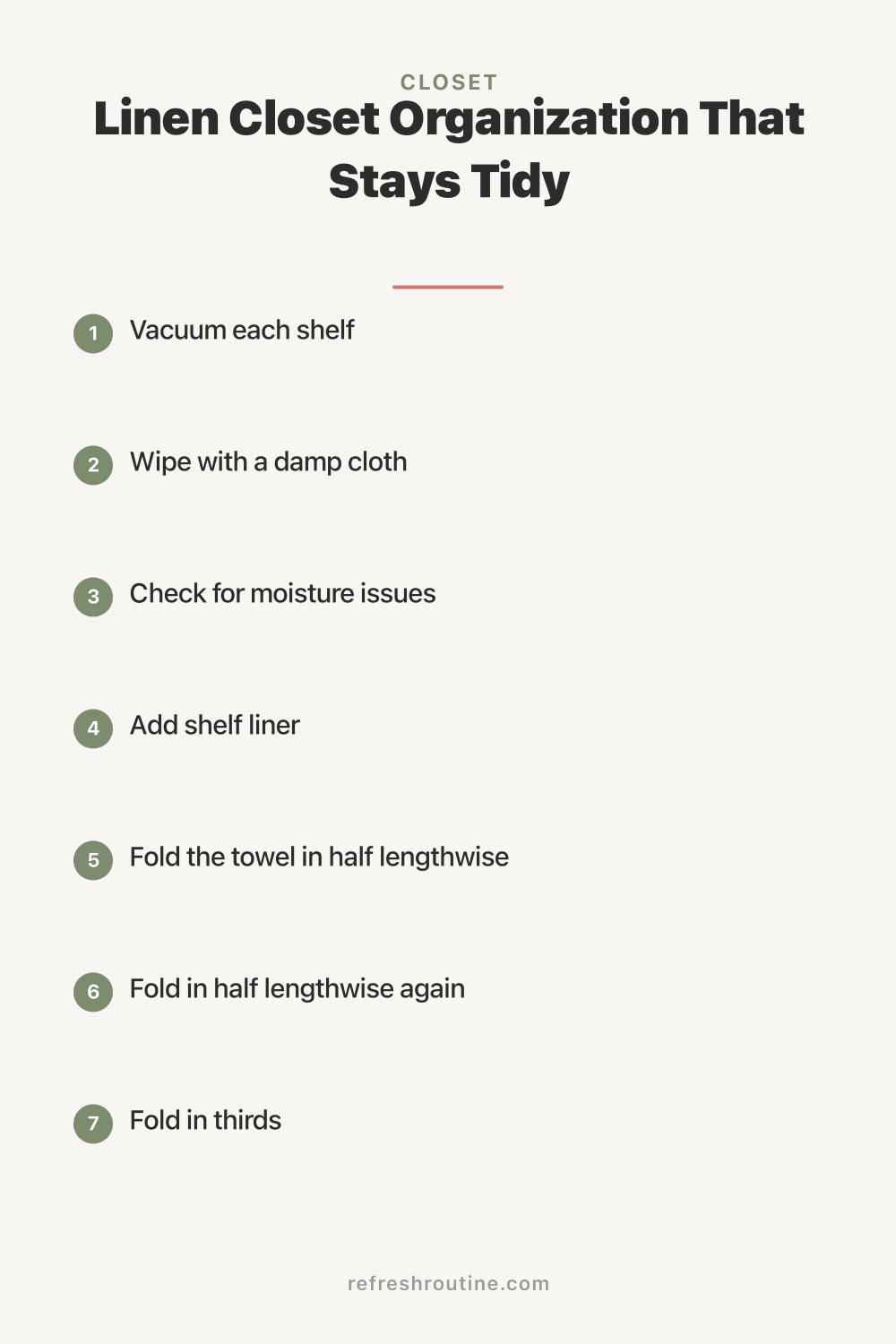
- Vacuum each shelf to remove dust and lint
- Wipe with a damp cloth and mild all-purpose cleaner
- Check for moisture issues. If shelves feel damp, you may need a small dehumidifier or moisture absorber
- Add shelf liner if shelves are wire (prevents items from getting marks)
Time estimate: 15 to 20 minutes for a standard linen closet.
This is also a good time to check if you need to adjust shelf heights. Most linen closet shelves are adjustable, and I moved mine to better fit how I fold my towels. Having the right shelf spacing eliminates the temptation to overstuff.
Step 3: Master the Folding Methods That Actually Matter
The difference between a linen closet that looks organized and one that looks chaotic comes down to consistent folding. You do not need to be a folding perfectionist, but consistent sizing makes stacking possible.
Towels: The Spa Fold
I learned this from a hotel housekeeping video, and it changed my towel shelves completely.
- Fold the towel in half lengthwise
- Fold in half lengthwise again (you now have a long strip)
- Fold in thirds by bringing one end to the center, then the other end over it
- Store with the folded edge facing out for a clean, spa-like look
This method creates uniform rectangles that stack neatly. My towel shelf went from a lumpy mess to something that looks like a display at a home goods store.
Sheets: The Pillowcase Trick
Fitted sheets are the bane of linen closets everywhere. Here is how I handle them.
- Fold the fitted sheet by tucking corners into each other to form a rough rectangle
- Fold the flat sheet into a matching rectangle
- Stack the fitted sheet, flat sheet, and one pillowcase
- Tuck the entire set inside the second pillowcase
Now each sheet set is a single, contained bundle. No more hunting for matching pieces. I label the pillowcase bundles with a small piece of painter’s tape noting the bed size and season.
Smart Towel Storage Ideas for Every Closet Size
Towels take up the most space in most linen closets. Here are the strategies I have tested:
- Roll guest towels instead of folding them. Rolled towels fit in baskets and look inviting
- Use shelf dividers to create sections for bath towels, hand towels, and washcloths
- Stack no more than 4 to 5 towels high. Taller stacks topple when you pull from the bottom
- Rotate towels using FIFO. FIFO stands for first in, first out. Place freshly washed towels at the bottom of the stack so older towels get used first, which prevents some towels from wearing out faster than others
According to the American Cleaning Institute, bath towels should be washed after 3 to 4 uses, and storing them properly between uses extends their lifespan by reducing fiber breakdown from being crammed into tight spaces.
If your linen closet is on the smaller side, our small closet organization ideas has vertical storage solutions that work for linens too.
How Many Towels Does a Household Actually Need?
For a family of four, you need approximately 8 to 12 bath towels (2 to 3 per person), 8 hand towels, and 8 to 12 washcloths. Add 4 guest towels if you host regularly. The common mistake is keeping every towel you have ever received as a gift or bought on sale. I had 26 bath towels for a family of four. That is more than double what we actually use between laundry days. Reducing to 10 bath towels freed up an entire shelf.
Step 4: Organize Blankets and Bulky Items
Blankets and comforters are the biggest space hogs in a linen closet. Here is how I manage them:
- Store bulky items on the highest shelf. You access them least frequently
- Use vacuum storage bags for off-season comforters. A king-size comforter compresses to about 75% of its original size
- Roll thin blankets and stand them upright like books
- Keep one throw blanket accessible on a lower shelf for everyday use
For seasonal items like heavy quilts or lightweight summer blankets, I rotate them twice a year. The seasonal clothing rotation system I use for my wardrobe works the same way for linens.
Cost: Vacuum storage bags run about $15 to $20 for a pack of 6 and last for years.
Step 5: Add Labels and Zones
Labels are not just for aesthetics. They are for everyone else in your household. My husband now puts towels back on the right shelf because it is labeled “Bath Towels.” My 7-year-old can grab her own sheets because they are labeled with her name.
My linen closet zones from top to bottom:
- Top shelf. Seasonal blankets, extra comforters, guest bedding
- Second shelf. Sheet sets organized by bed (master, kids, guest)
- Third shelf (eye level). Bath towels and hand towels
- Fourth shelf. Washcloths, cleaning rags, reusable cloths
- Bottom shelf or floor. Laundry supplies, extra toiletries, first aid kit
This zone system works because you access towels and washcloths most often. Putting them at eye and hand level eliminates the need to reach or bend.
What I Wish I Knew About Linen Closet Organization
Wire shelves need liner. Without shelf liner, folded items get indentation marks and can slip through gaps. A roll of non-adhesive shelf liner costs about $8 and makes a huge difference.
Matching towel sets look better and function better. I used to have towels in every color from 10 years of random purchases. Switching to all white bath towels (bleach-friendly) and all gray hand towels simplified my closet visually and made laundry sorting easier.
Lavender sachets prevent mustiness. Linen closets can develop a stale smell, especially in humid climates. I tuck a lavender sachet on each shelf. Cedar blocks work too but need sanding every few months to refresh the scent.
Do not store items in plastic bags long-term. Plastic traps moisture and can cause mildew on natural fibers. Use breathable cotton storage bags for anything stored longer than a season.
Seasonal bedding swaps take 10 minutes. I dreaded this task until I actually timed it. Swapping flannel sheets for percale in spring took exactly 10 minutes. The dread was worse than the task.
Maintaining Your Organized Linen Closet
Once your linen closet is organized, maintenance is minimal. I spend about 5 minutes per week keeping it tidy, usually when I put away clean laundry.
My maintenance rules:
- Refold anything that has gotten messy when putting away clean items
- Return items to their designated zone immediately after laundering
- Do a quick edit every 6 months. Check towels for wear. Remove anything that has become threadbare
- Replace shelf labels if they peel or fade
The key to a linen closet that stays organized is having a place for everything and not overstuffing any shelf. If you find yourself cramming items in, it is time for another edit. The same principle applies throughout your home, as our decluttering room-by-room checklist explains.
Pairing your linen closet routine with a daily cleaning routine means clean towels and fresh sheets become part of your regular rhythm rather than a chaotic scramble.
Key Takeaway
Linen closet organization comes down to three things: editing your inventory to only what you actually use, folding consistently so items stack neatly, and assigning zones so every shelf has a clear purpose. Start by pulling everything out and reducing your towel and sheet count to practical numbers. The pillowcase trick for sheet sets and the spa fold for towels will keep your closet looking intentional with minimal effort.
Keep Your Closets Organized
Your linen closet is just one part of a fully organized home. Explore our complete closet organization guide for more strategies, or visit our pantry organization guide to bring the same zone-based system to your kitchen.

Frequently Asked Questions
How often should you replace towels and sheets?
Replace bath towels every 2 to 3 years and sheets every 2 to 3 years depending on quality and frequency of use. Signs of replacement include thinning fabric, loss of absorbency in towels, pilling on sheets, and permanent stains that do not wash out.
How many sets of sheets should you keep per bed?
Keep 2 to 3 sets of sheets per bed. One set on the bed, one clean set ready to go, and optionally one seasonal set (flannel for winter or lighter percale for summer). More than 3 sets per bed creates unnecessary clutter.
What is the best way to fold fitted sheets for storage?
Tuck each corner pocket into the next to form a rectangle, then fold into thirds both ways. Store fitted sheets inside one of their matching pillowcases to keep sets together and prevent messy unfolding on the shelf.