KonMari Method Explained: A Step-by-Step Decluttering Guide

Three years ago, I read Marie Kondo’s book on a Friday night and by Saturday morning I had dumped every piece of clothing I owned onto my bed. All of it. The pile was so tall my four-year-old asked if we were having a yard sale. That moment was terrifying and liberating at the same time.
The KonMari method is one of the most popular decluttering approaches in the world, and for good reason. It works. But it’s also widely misunderstood. People think it’s just about asking “does this spark joy?” while holding a sweater. There’s much more to it, and once you understand the full system, it becomes one of the most effective ways to transform your home permanently.
Marie Kondo’s book The Life-Changing Magic of Tidying Up has sold over 13 million copies worldwide, making it one of the best-selling organizing books in history. That kind of reach doesn’t happen without real results.
What Is the KonMari Method?
The KonMari method is a decluttering system created by Japanese organizing consultant Marie Kondo. Instead of organizing room by room, you declutter by category in a specific order: clothes, books, papers, miscellaneous items, and sentimental items. For each item, you hold it and ask whether it “sparks joy.” Items that spark joy stay. Everything else is thanked and released.
The key insight that separates KonMari from other methods is the category-based approach. When you declutter by room, you miss duplicates scattered across the house. I had winter scarves in three different closets and didn’t realize it until I gathered every scarf into one pile. Seeing 14 scarves on my bed made the decision very clear.
The 5 KonMari Categories in Order
Marie Kondo insists on following this specific order, and after trying it myself, I understand why. Each category builds your decision-making skills for the next one.
1. Clothing
Start here because clothing decisions are the easiest. You wear it or you don’t.
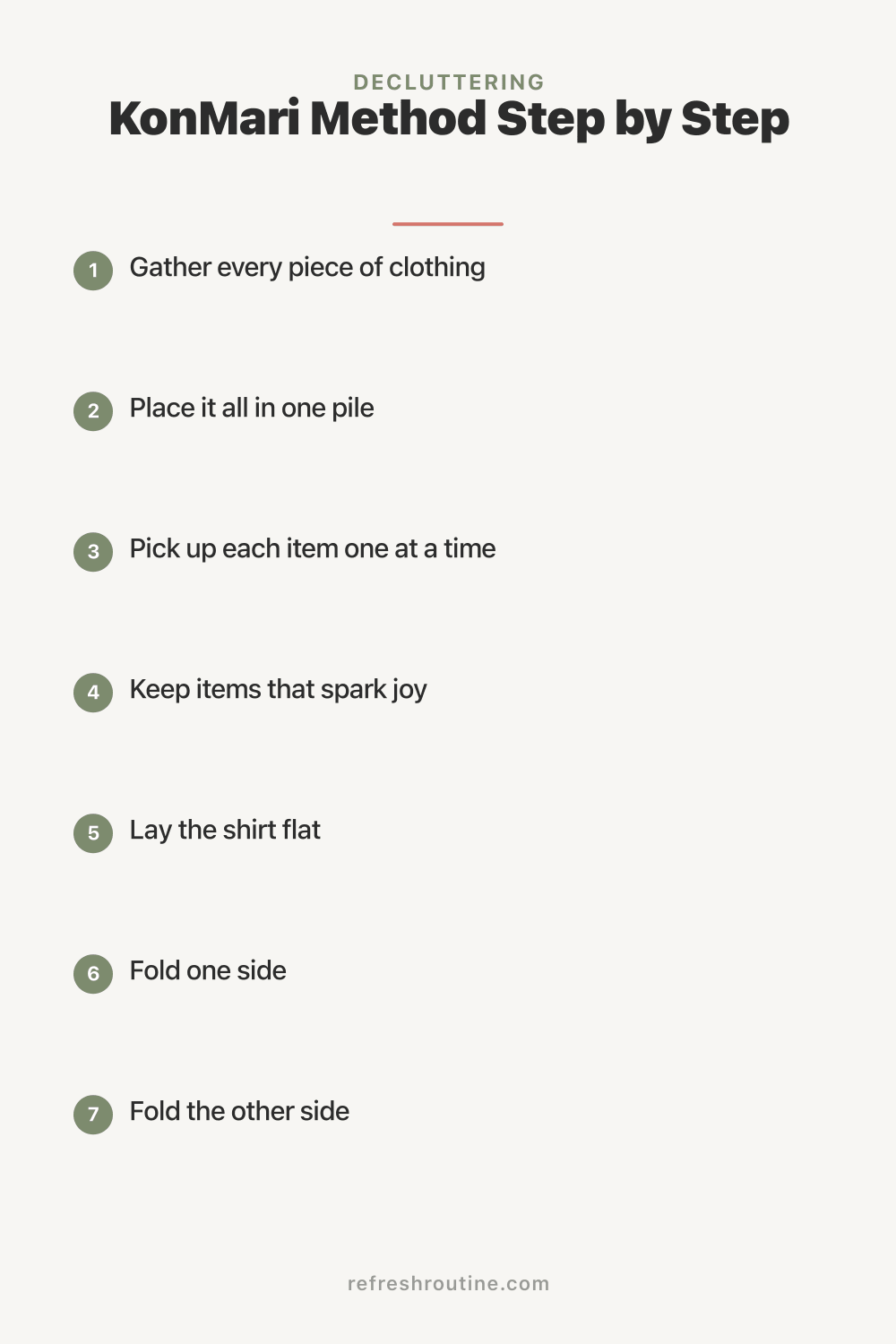
- Gather every piece of clothing from every room, closet, drawer, and laundry basket in your home. Yes, all of it.
- Place it all in one pile on your bed or floor.
- Pick up each item one at a time and hold it. Ask yourself: “Does this spark joy?”
- Keep items that spark joy. Thank and release the rest.
When I did this step, my clothing pile covered my entire queen-size bed and spilled onto the floor. I removed 68 items that day. Some were easy decisions, like the jeans from 2017 that hadn’t fit in years. Others were harder, like the blazer from my first day as a project manager. But holding each piece and being honest about how it made me feel changed the way I think about what I own.
Pro tip: If you’re stuck on an item, put it on. Stand in front of the mirror. Your body language will tell you everything. If you tug at it, adjust it, or frown, it doesn’t spark joy.
A study published in the Journal of Environmental Psychology found that people who feel attached to fewer possessions report higher life satisfaction. Letting go of clothes you don’t love makes room for the ones you do.
2. Books
Books are harder than clothes because they carry intellectual guilt. We keep books we “should” read or books we paid good money for but never opened.
- Gather every book from shelves, nightstands, closets, and storage.
- Hold each one and ask if it sparks joy.
- Let go of books you’ve already read and won’t reread, books you bought but never started, and reference books you can find online.
I donated 42 books during this step. The hardest ones to release were the business books I’d bought with good intentions but never cracked open. I realized keeping them on my shelf didn’t transfer the knowledge inside them to my brain.
3. Papers
Marie Kondo’s rule for papers is simple: discard everything. The exceptions are papers currently in use, papers needed for a limited time, and papers that must be kept indefinitely (tax returns, contracts, certificates).
- Sort papers into three categories: active, temporary, and permanent.
- Shred or recycle everything else.
- Digitize what you can. A phone photo of a warranty card works just as well as the paper version.
The average household receives approximately 41 pounds of junk mail per year (EPA). Add in school papers, receipts, and old bills, and paper clutter builds up faster than almost any other category.
4. Komono (Miscellaneous Items)
This is the largest category, and Kondo breaks it into sub-categories:
- Kitchen items (utensils, gadgets, food storage)
- Bathroom products (skincare, makeup, hair tools)
- Cleaning supplies
- Electronics and cords
- Hobby and craft supplies
- Tools and hardware
Work through one sub-category at a time. Don’t try to do all of komono in a single weekend. I spread this category across three weeks, tackling one sub-category per session.
The kitchen alone took me two full sessions. I found three can openers, two garlic presses, and a fondue set still in its original packaging from our wedding registry. My pantry organization guide covers the food and pantry portion of this category in detail.
5. Sentimental Items
This category comes last on purpose. By the time you reach it, you’ve practiced making hundreds of keep-or-release decisions. Your “spark joy” instinct is sharp.
- Gather photos, letters, children’s artwork, heirlooms, and mementos.
- Hold each one. Notice whether it sparks genuine joy or just guilt and obligation.
- Keep what truly matters. Photograph the rest before releasing it.
I’ll be honest. This was the hardest category for me. I sat on my living room floor with a box of my grandmother’s costume jewelry and cried. I kept five pieces that I actually wear and let the rest go to family members who wanted them. The memories live in me, not in the objects.
Does the KonMari Method Really Work Long Term?
Yes. The KonMari method produces lasting results because it changes how you think about ownership, not just how you organize. According to a survey by the KonMari organization, 80% of people who complete the full method report maintaining their tidy homes one year later. The “spark joy” test becomes a filter you apply to new purchases automatically, which prevents clutter from returning.
My experience confirms this. It’s been three years since I did my full KonMari tidying festival, and my home has stayed consistently manageable. Not perfect, but manageable. I still have a junk drawer. But I don’t have 14 scarves anymore.
The KonMari Folding Method
One of the most practical parts of the KonMari method is the folding technique. Instead of stacking clothes in drawers, you fold each item into a small rectangle that stands upright on its edge.
Here’s how to fold a basic t-shirt the KonMari way:
- Lay the shirt flat face down.
- Fold one side toward the center, including the sleeve.
- Fold the other side the same way, creating a long rectangle.
- Fold the bottom up to about one-third.
- Fold again so the shirt stands upright on its own.
The result is a small, neat rectangle you can file vertically in a drawer, like files in a filing cabinet. This means you can see every item at a glance when you open the drawer.
I was skeptical about this at first, but it genuinely changed how my drawers function. I used to dig through stacks of t-shirts and mess up the whole pile looking for one specific shirt. Now I can see all 12 shirts the moment I open the drawer. For closet-specific tips beyond folding, our small closet organization ideas guide covers maximizing hanging and shelf space.
What I Wish I Knew Before Starting KonMari
-
It takes longer than you think. Marie Kondo says the process takes about six months. I thought I’d finish in three weeks. It took me four months, and that’s a realistic timeline for a family with two kids.
-
“Spark joy” feels weird at first. The first time I held a spatula and asked if it sparked joy, I felt ridiculous. But after a few rounds, you start to notice the difference between items that make you feel something positive and items that make you feel nothing or guilt.
-
You will feel worse before you feel better. When all your clothes are piled on the bed and it’s 4 PM and you still have half the pile to go, it’s overwhelming. Push through. The other side is worth it.
-
Don’t start with sentimental items. I know someone who started with her grandmother’s things and got so emotional she gave up entirely. The category order exists for a reason. Trust it.
-
Your family might not be on board. My husband was skeptical for the first two weeks. He came around when he could actually find his socks. Focus on your own things first. If you need help getting started, our guide on where to start decluttering breaks the process into smaller steps.
How Is KonMari Different From Other Decluttering Methods?
The biggest difference is the category-first approach. Most decluttering advice tells you to work room by room. KonMari works by category because it forces you to confront the total volume of what you own. When you see 30 t-shirts in one pile instead of 10 spread across three drawers, the excess becomes obvious.
The other difference is the emotional component. KonMari asks you to tune into how items make you feel instead of applying strict rules like “if you haven’t used it in a year, toss it.” For some people, that emotional approach works better than logical rules. For others, it doesn’t. If you prefer a more structured, task-based approach, our room-by-room decluttering checklist might be a better fit.
According to the National Association of Productivity and Organizing Professionals, the average person spends one year of their life looking for lost items. Whether you use KonMari or another method, reducing the number of things in your home reduces the time you spend searching for them.
Key Takeaway
The KonMari method works because it addresses the root cause of clutter, which is keeping things that don’t add value to your life. By working through five categories in order and asking whether each item sparks joy, you build decision-making skills that prevent clutter from returning. Start with clothing, trust the process, and give yourself several months to work through the full system.
What’s Next?
If you’re ready to start your KonMari journey, begin with the clothing category today. For a broader view of all decluttering approaches, visit our complete decluttering guide. And if you want daily structure, our desk organization guide applies KonMari principles to your workspace for a quick, satisfying project.

Frequently Asked Questions
How long does the KonMari method take to complete?
Most families complete the full KonMari method in 3 to 6 months, working through one category at a time. Marie Kondo recommends finishing within six months to maintain momentum. Rushing leads to burnout, so pace yourself by category.
Does the KonMari method work for families with kids?
Yes, but with adjustments. Children under 10 need help identifying what sparks joy. Focus on your own belongings first, then guide kids through their toys and clothes category by category. Let them make final decisions about their own items.
What is the correct KonMari folding method?
KonMari folding turns each garment into a small rectangle that stands upright in a drawer. Fold items into thirds or quarters so they can stand on their own edge. This lets you see every item at a glance instead of stacking.