The 12-12-12 Decluttering Method: Fast, Simple, Effective
I have a friend who declutters her entire weekend away every spring. Three days, full marathon, exhausted by Sunday night. By June, the house is back to cluttered. Year after year.
The 12-12-12 method is the opposite. Quick, structured, repeatable. Here is how it works and why it might be the right system for you.
The 12-12-12 Method Explained
The method, popularized by Joshua Becker of Becoming Minimalist, has three simple categories:
- 12 items to throw away
- 12 items to donate
- 12 items to return to their proper home
Find these 36 items in one decluttering session. That is the whole method.
The structure provides three things missing from unstructured decluttering:
- Clear goal: 36 items, defined categories
- Time-bound: 30 to 60 minutes typically
- Manageable scope: Small enough to do regularly
Why Structure Beats Marathons
According to research on habit formation, small repeated actions outperform infrequent large ones for behavior change. The 12-12-12 method aligns with this finding.
Compared to weekend marathons:
- Sustainability: Can do weekly forever
- Lower barrier: 36 items feels possible; “clean the basement” feels impossible
- Compound effect: 36 items weekly = 1,872 items per year
- Less burnout: 30 to 60 minutes is recoverable
The numbers are surprising. Two months of weekly 12-12-12 sessions equals 288 items addressed. That is more than most weekend marathon sessions accomplish.
What Makes the 12-12-12 Method Work?
The 12-12-12 method works because the structure (three clear categories, specific numbers, defined session) eliminates the decision paralysis that derails unstructured decluttering. The session has a clear end. The categories prevent the “where does this go” question. The numbers create momentum through small wins. Together, these elements make decluttering feel like a game, not a chore.
How to Run a 12-12-12 Session
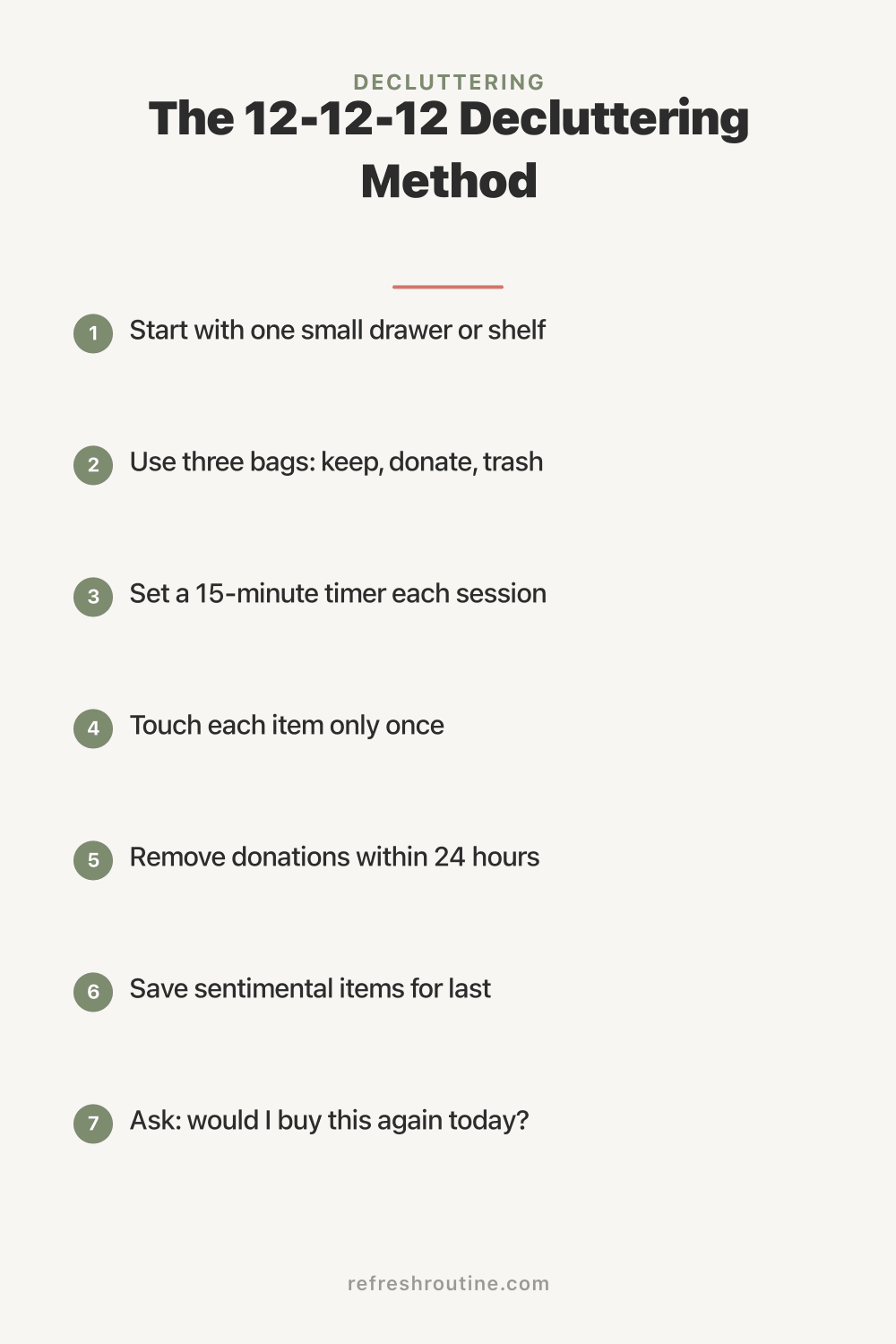
Step 1: Set Up (5 min)
Grab three containers:
- Trash bag: For toss items
- Donate box: For donate items
- Empty basket or tray: For relocate items
Set a timer for 60 minutes. The timer is the boundary.
Step 2: Walk Through the House (40-50 min)
Walk through one room at a time. In each room, look for items that fit one of the three categories.
12 items to throw away: Broken, expired, garbage. Examples:
- Old receipts
- Expired food
- Broken toys
- Dried-up pens
- Used tissues from kid’s pocket
- Junk mail
- Expired coupons
12 items to donate: Working but unused. Examples:
- Books read once
- Clothes that do not fit
- Kitchen gadgets unused
- Duplicate items
- Old decor
- Toys outgrown
12 items to return: Items in the wrong place. Examples:
- Coffee mug in the bathroom
- Book in the kitchen
- Toy in the entryway
- Sock under the couch
- Tool from the garage in the living room
Step 3: Process Each Pile (10 min)
- Trash bag: Carry to outdoor bin immediately
- Donate box: Place in car for next errand
- Relocate basket: Walk through house putting items in their proper homes
Total time: 50 to 65 minutes. Done.
What I Wish I Knew About 12-12-12
After 2 years of monthly 12-12-12 sessions, here is what helped most.
The toss pile fills fastest. Trash and expired items add up quickly. Start there if you feel overwhelmed.
Donate is the meaningful work. Donating 12 working items weekly redistributes 624 items per year. That is one full household worth of items.
Relocate solves the chaos. Most household chaos comes from items not in their proper places. The 12 relocates per session keep the home looking organized.
You can scale up or down. When energized, do 24-24-24 (one hour for 72 items). When tired, do 6-6-6 (15 minutes for 18 items). The structure scales.
Same time weekly is the secret. I do mine Sunday at 4 PM. The consistency removes the decision.
Variations of the Method
6-6-6 (Beginner)
Half the standard method. 6 toss, 6 donate, 6 relocate. 18 items total. Done in 15 to 30 minutes. Great for low-energy days or starting the habit.
24-24-24 (Power Session)
Double the standard. 24 toss, 24 donate, 24 relocate. 72 items. 90 to 120 minutes. For motivated days or after holidays when accumulation is high.
12-12-12-12 (Plus Sell)
Add a fourth category: 12 items to sell. Useful for households with items of value. The sell pile gets photographed and listed within 1 week.
Themed 12-12-12
Each session focuses on one room or category:
- Kitchen 12-12-12 (35 to 60 minutes)
- Closet 12-12-12 (40 minutes)
- Garage 12-12-12 (60 minutes)
Themed sessions go deeper in one area instead of spreading across the house.
Building a 12-12-12 Habit
The method works best as a recurring habit:
Week 1 to 4: Run weekly to build momentum Month 2 to 3: Biweekly for maintenance Long-term: Monthly for ongoing maintenance
Pair with existing routines for stickiness:
- After Sunday morning coffee
- Saturday before laundry
- Friday afternoon after work
- Sunday evening before the week
Same time and trigger makes the habit automatic.
How Long Until You See Results?
You will see visible results after one 12-12-12 session. Significant changes appear after 4 sessions (144 items processed). A home that did weekly 12-12-12 for 3 months would have 432 items addressed, which is comparable to a full weekend declutter marathon spread across 90 minutes per week.
12-12-12 by Room
Kitchen
Easy 12 toss: Expired spices, expired condiments, broken utensils, mismatched lids, stained dish towels, takeout sauce packets, expired coupons
Easy 12 donate: Duplicate gadgets, mugs you do not use, cookbooks you do not reference, extra plates, mismatched silverware
Easy 12 relocate: Items that drifted from other rooms (mail, kid items, etc.)
Living Room
Easy 12 toss: Old magazines, junk mail, expired coupons, broken decor, used tissues, dried up pens
Easy 12 donate: DVDs no one watches, books you have read, throw pillows you do not love, decorative items no longer meaningful
Easy 12 relocate: Coffee cups, dishes, kid toys, laundry items
Bathroom
Easy 12 toss: Expired makeup, expired skincare, hotel toiletries, old toothbrushes, almost-empty bottles, expired medications
Easy 12 donate: Unopened toiletries you do not love, hair tools you do not use, decorative items
Easy 12 relocate: Items in the wrong room (cup from kitchen, book, etc.)
Bedroom
Easy 12 toss: Old receipts in nightstand, broken jewelry, stretched out socks, worn pajamas, expired prescriptions
Easy 12 donate: Clothes that do not fit, shoes unworn, accessories unused, books from nightstand
Easy 12 relocate: Coffee cups, dishes from kid snacks, items from other rooms
Office or Home Office
Easy 12 toss: Expired papers, dried pens, old printouts, junk mail, expired warranty docs
Easy 12 donate: Books you have read, office supplies in duplicate, old electronics, items from old jobs
Easy 12 relocate: Items from kitchen, kid school papers, household items
When 12-12-12 Is Not Enough
The method works for routine maintenance but is not enough for:
Major life transitions: Moves, downsizing, deaths in family. Use decluttering before moving guide instead.
Specific room overhauls: Garage, attic, or basement need dedicated time, not just 12 items.
Sentimental items: Save these for slower, more thoughtful sessions.
Heavy accumulation: Hoarding tendencies need professional support, not just 12-12-12.
Use the method alongside other approaches for complete clutter management.
Comparing 12-12-12 to Other Methods
Versus the 4-Box Method
4-box method is for whole-room sessions. 12-12-12 is for quick walkthrough sessions. Use 4-box for deep work; 12-12-12 for maintenance.
Versus the 30-Day Challenge
30-day challenge is daily, specific assignments. 12-12-12 is flexible, repeatable sessions. Daily challenges build momentum; 12-12-12 sustains it.
Versus KonMari
KonMari is a one-time complete reorganization. 12-12-12 is ongoing maintenance. Use KonMari to establish, 12-12-12 to maintain.
Versus the 20/20 Rule
20/20 rule is a decision framework for individual items. 12-12-12 is a structured session format. The two work together: apply 20/20 within a 12-12-12 session.
Family 12-12-12
Run as a family challenge:
Everyone participates: Each family member finds their 12-12-12 Race or collaboration: Compete or work together Reward: End with ice cream, movie, walk together Track over time: Calendar with checkmarks for completed sessions
Kids especially enjoy the structure and quick wins.
Long-Term Results
After 6 months of weekly 12-12-12 sessions:
- 936 items addressed total
- 312 items donated to charity
- 312 items removed (trash)
- 312 items returned to proper homes
- Home stays consistently organized
- Less stress about clutter
- Habit feels automatic
The method’s power is consistency. Small weekly action compounds dramatically.
Key Takeaway
The 12-12-12 method (12 toss, 12 donate, 12 relocate) makes decluttering manageable through structure, specificity, and repetition. Each session takes 30 to 60 minutes and addresses 36 items. Weekly sessions build momentum; monthly maintenance keeps homes organized long-term. The method works because the structure removes decision paralysis, the categories prevent the “where does this go” question, and the numbers create satisfying small wins. Most homes can transform within 3 months of weekly 12-12-12 sessions. Start this Sunday. Set a timer for 60 minutes. Find your first 36 items. The momentum will carry you forward.
For more decluttering methods, see our 4-box method and 15-minute daily declutter guides.

Frequently Asked Questions
What is the 12-12-12 decluttering method?
The 12-12-12 method involves finding 12 items to throw away, 12 items to donate, and 12 items to return to their proper home in one decluttering session. Total: 36 items addressed in 30 to 60 minutes. The structure provides clear goals and prevents the overwhelm of unstructured decluttering.
Who created the 12-12-12 method?
The 12-12-12 method was popularized by Joshua Becker of Becoming Minimalist. It draws on the broader simplicity movement and is designed for people who want quick wins without overwhelming commitment. The method has been adopted by many minimalism communities.
How often should you do the 12-12-12 challenge?
Do the 12-12-12 challenge weekly for the first month to build momentum, then biweekly or monthly for maintenance. Each session takes 30 to 60 minutes. After 4 to 6 sessions, you will have addressed 144 to 216 items, which is substantial for most homes. After that, monthly sessions prevent re-accumulation.