Workbench Organization: Pegboard, Drawers, and Tool Walls

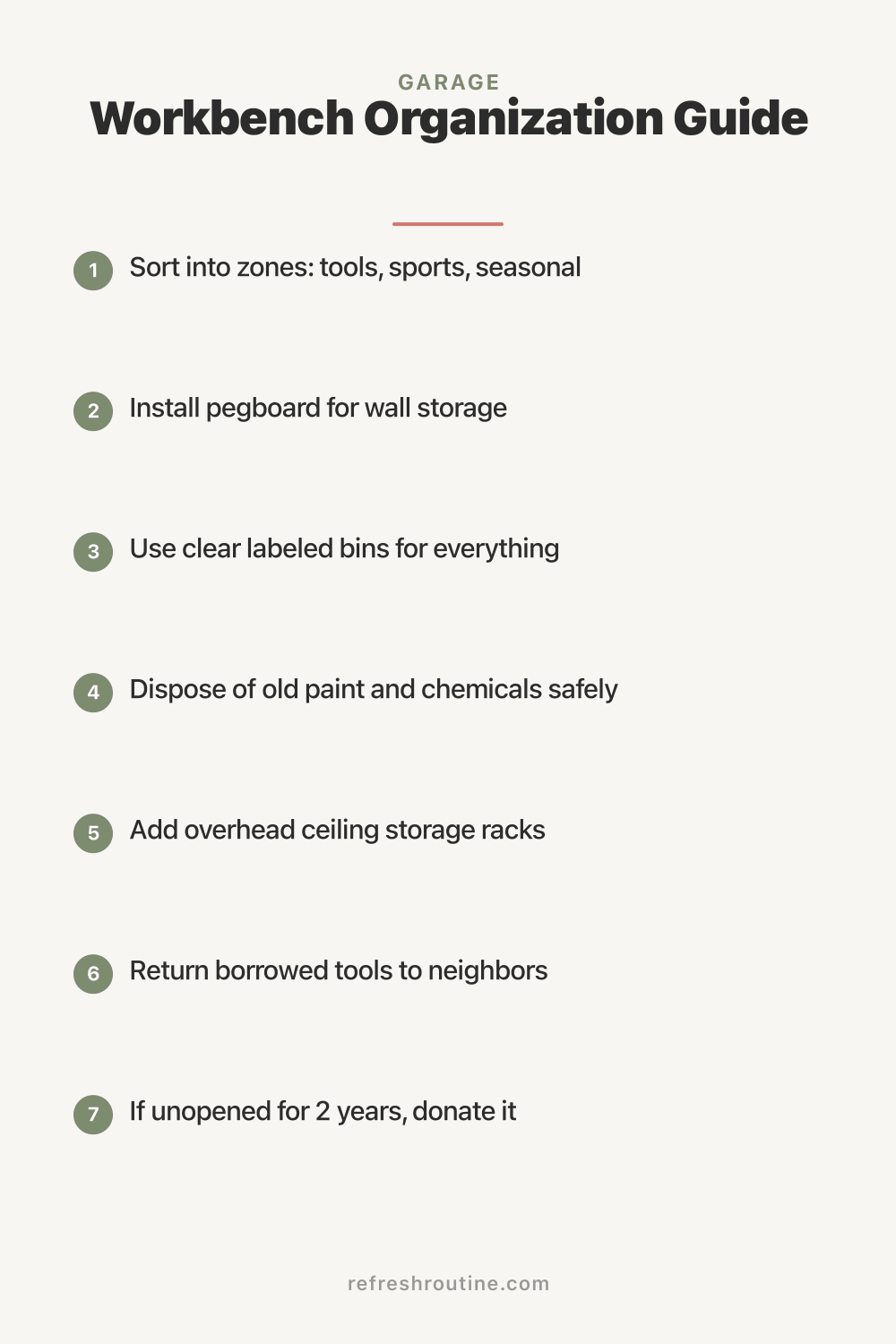
My workbench was the chaos zone of our garage. Tools scattered across the surface. Hardware mixed in jars. Project pieces piling on top of unfinished work. Every project required 15 minutes of clearing before I could start.
The fix was pegboard plus drawer system. Now everything has a place. Projects start immediately. Here is the complete workbench organization.
Why Workbench Organization Matters
A disorganized workbench costs:
- Project start time: 15+ minutes clearing before work
- Tool damage: Wrong tools used, items lost
- Project quality: Mistakes from wrong tools or rushed setup
- Safety: Hazards on cluttered surface
- Time waste: Searching for hardware, tools
According to research from Bob Vila, an organized workbench increases project completion rate by 40% because the barrier to starting drops significantly.
What Is the Best Workbench Organization?
The best workbench organization keeps the working surface clear (only current project tools and materials), uses pegboard or wall storage for visible tools, drawers for small parts and hardware, and a defined workflow (cutting station, assembly station, finishing area). Most workbench problems are storage problems, not surface problems.
The Workbench Reset Process
Step 1: Clear Everything (60 min)
Pull every item off and from the workbench:
- Tools
- Hardware
- Project pieces
- Misc items
You probably have more than you realized.
Step 2: Sort by Category (60 min)
Group items:
- Hand tools (hammers, screwdrivers, wrenches)
- Power tools (drills, sanders, saws)
- Cutting tools (saws, knives, scissors)
- Measuring (tape, levels, squares)
- Hardware (screws, nails, bolts)
- Fasteners (clips, ties, brackets)
- Safety equipment
- Project supplies
Step 3: Decide What Stays (45 min)
Donate:
- Tools you have multiples of
- Tools you have not used in 2 years
- Hardware for projects you abandoned
Keep:
- Tools used regularly
- Hardware in active sizes
- Project-specific items
Toss:
- Damaged tools
- Rusted or dangerous items
- Empty containers
For garage decluttering, see our garage decluttering guide.
Step 4: Install Pegboard (90 min)
If not already installed:
- Mount above workbench
- Use 1/4” pegboard with proper hooks
- Test arrangement before mounting all hooks
- Hang most-used tools at eye level
For pegboard setup, see our garage pegboard guide.
Step 5: Set Up Drawers (60 min)
For tools that need protection or are small:
- Small drawer organizers for screws and small hardware
- Larger drawers for measuring tools
- Designated drawer for power tool accessories
- Cabinet for power tools themselves
Step 6: Arrange Workbench Top (15 min)
Clear surface with:
- Designated outlet area (multiple outlets)
- Vise mounted to one end
- Magnetic strip for small metal parts
- Designated cup for current project hardware
- Small trash basket near working position
What I Wish I Knew About Workbench Organization
After multiple workbench iterations, here is what helped most.
Visible tools on pegboard. Items I can see, I use. Items in drawers I forget.
Outlines on pegboard. I drew outlines around each tool. Helps me know where to return tools.
Hardware in drawers. Loose hardware on surface = chaos. Drawers contain it.
Magnet strip is incredible. Holds screws, drill bits, small metal pieces. Saves the “where did that screw go” search.
Lighting matters. Bright LED above workbench transformed my work quality.
How Do You Maintain Workbench Organization?
Maintain workbench organization with the 5-minute reset rule: after each project session, spend 5 minutes returning tools, sweeping scrap, and clearing surface. This prevents the slow accumulation that creates chaos. Combined with quarterly deep cleans, the workbench stays functional for years.
Pegboard Layout Strategy
Eye-Level (Most-Used)
At chest height when standing:
- Hammer
- Screwdrivers (most-used sizes)
- Pliers
- Most-used wrenches
- Tape measure
- Utility knife
Above Eye-Level
For occasional tools:
- Less-used hand tools
- Specialty tools
- Backup items
Below Eye-Level
For heavier or larger tools:
- Larger wrenches
- Specific saws
- Heavy hammers
Categories Together
Group similar tools:
- All screwdrivers in one section
- All wrenches in another
- All cutting tools together
This makes finding tools intuitive.
Drawer Organization
Small Drawers (Top)
- Common screws by size
- Common nails by size
- Small hardware (washers, nuts)
- Drill bits in organizer
Medium Drawers (Middle)
- Tape, glue, sealants
- Measuring tools
- Specialty fasteners
- Working notebook and pencils
Large Drawers (Bottom)
- Power tool accessories
- Larger tools not on pegboard
- Project supplies
- Specialty equipment
Drawer Dividers
Use compartmented organizers in each drawer. Prevents items from mixing.
For specific tool organization, see our tool organization guide.
Specific Tool Storage
Power Tools
- Cordless tool brackets on pegboard
- Battery charger station
- Tool case storage on shelf
- Specific drawer for accessories
Hand Tools
- Hammers: Pegboard hook
- Screwdrivers: Holder rack or pegboard
- Wrenches: Wrench rack or pegboard
- Pliers: Pegboard or drawer
- Specialty: Designated location
Cutting Tools
- Hand saws: Wall-mounted holder
- Power saws: Case storage
- Knives: Magnetic strip or holder
- Scissors: Drawer with safety guard
Measuring Tools
- Tape measures: Pegboard hook
- Levels (2 to 4 foot): Wall-mounted bracket
- Squares: Pegboard
- Specialty: Designated drawer
Hardware (Screws, Nails, etc.)
- Sorted by type and size
- Drawer compartments
- Wall-mounted bins or jars
- Common sizes accessible
Workbench Surface Organization
The clear surface needs:
Cutting zone: For saw work Assembly zone: For putting things together Layout zone: For planning Finishing zone: For sanding and paint
Defined zones improve project flow.
Common Workbench Organization Mistakes
After multiple iterations:
Mistake 1: Surface as storage. Tools accumulate, project space disappears.
Mistake 2: No pegboard. Tools become a pile.
Mistake 3: Mixed hardware in single container. Slows down work.
Mistake 4: No defined zones. Workflow suffers.
Mistake 5: Skipping maintenance. Chaos returns.
For more garage organization, see our garage workshop setup and garage zones guides.
Specific Workshop Types
Woodworking Focus
- Larger workbench (8 feet ideal)
- Designated cutting station
- Lumber rack nearby
- Vise mounted firmly
- Dust collection setup
For specific woodworking, see our garage workshop setup.
General DIY
- Standard 6-foot workbench
- Versatile organization
- Multiple hardware types
- Variety of tools
Auto Repair
- Lower workbench (mechanic style)
- Specific tool organization
- Designated area for parts
- Greasy/oily tool separation
Crafts Focus
- Higher workbench for sitting
- Smaller hardware
- Designated craft supplies
- Better lighting
Workshop Lighting
Critical for project quality:
- Overhead LED bars
- Task lighting at workbench
- Movable spot light
- Good color rendering (5000K)
For workshop lighting, see our garage workshop setup.
Safety Considerations
Workbench safety:
- First aid kit accessible
- Fire extinguisher at exit
- Adequate ventilation
- PPE accessible
- Tool guards in place
- Children’s safety lock if needed
Maintaining the Workbench
After setup:
During project (every 30 min): 60-second clear of scrap End of session (5 min): Return tools, sweep, reset Weekly (15 min): Visual check, restock if needed Monthly (30 min): Full reorganization check Quarterly (90 min): Major cleaning, refresh
Maintenance prevents the slow accumulation.
Storage Beyond the Workbench
For the workshop:
- Lumber rack: Wall-mounted for boards
- Hardware cabinet: Floor cabinet for bulk supplies
- Power tool cases: Shelving for tool cases
- Project materials: Designated area for current materials
- Finished projects: Quick output zone
For garage zones, see our garage zones guide.
Investment Strategy
Build the workshop over time:
Year 1 ($200 to $400)
- Solid workbench
- Basic pegboard system
- Hand tools and basic power tools
- Hardware organization
Year 2 ($300 to $600)
- Better lighting
- Power tool expansion
- Additional storage
- Quality safety equipment
Year 3+ ($300 to $1000+)
- Specialty tools
- Advanced organization
- Dust collection
- Specialty equipment
Family Workshop Considerations
For households with multiple users:
- Kid-friendly tools: Designated section
- Safety education: Tools and rules
- Project supervision: Adults guide kids
- Locks on dangerous tools: When kids are present
- Shared space: Multiple users coordinate
Workshop Storage Photo Documentation
After setup:
- Take photos of each pegboard layout
- Document each drawer contents
- Photograph specialty storage
- Create reference for re-setup if items moved
These photos help maintain organization over time.
Key Takeaway
Workbench organization works through pegboard for visible tools, drawers for small parts and hardware, and a clear surface for active work. Setup takes 4 to 6 hours total. Tools become findable, projects become easier to start, and the workspace becomes inviting rather than dreaded. The 5-minute reset rule after each session prevents chaos. Combined with quarterly deep cleans, the workbench stays functional for years. Total investment: $200 to $600 in storage and organization. Most homes recover this in increased project completion and reduced tool replacement costs.
For more garage and workshop organization, see our garage workshop setup, garage pegboard, tool organization, and garage zones guides.

Frequently Asked Questions
What should be on a workbench?
Items that should be on or near a workbench: tools currently used in project, measurement tools (tape, level), safety equipment (glasses, gloves), basic hardware (screws, nails), a clamp or vise, lighting, and waste container. Everything else should be in nearby storage (pegboard, drawers, shelves).
How do you organize tools on a pegboard?
Organize pegboard tools by frequency and category: most-used tools at eye level (chest height), categorized by function (cutting, measuring, fastening), with outlines drawn for each tool to show where it belongs. Keep similar tools together. Use specific holders for unusual shapes.
How do you keep a workbench clean during projects?
Keep a workbench clean by taking 60 seconds to clear scrap and dust every 30 minutes during a project, having a dedicated waste container, using a magnetic strip for small metal pieces, and ending each session with a 5-minute reset. The 5 minutes saves 30 minutes at the start of next project.