Office Supplies Organization: Tame the Pen Drawer Forever
I once counted the pens in our home office. 47 pens. Only 8 worked. The drawer had 12 dried-out highlighters, 3 broken staplers, and a calculator from 2003 that no longer worked.
Office supplies accumulate faster than other categories because each item is small and easy to add. The fix is a clear system. Here is what works.
Why Office Supplies Get So Disorganized
Supplies multiply for predictable reasons:
- Small items: Each individual item is small enough to not feel like clutter
- Easy to buy: Available everywhere, often inexpensive
- Multiple sources: Bought, given as gifts, brought home from work
- No expiration sense: Pens and paper feel “useful someday”
- Drawer migration: Items drift between drawers
According to a survey by OfficeMax, the average household has 3 to 5 times more office supplies than they need or use. Decluttering plus organization solves both problems.
What Is the Best Office Supplies System?
The best office supplies system uses defined containers for specific categories: a pen cup for daily-use pens (5 to 10), drawer organizers for backup supplies, shelf storage for paper and folders, and designated spots for cables and electronics. Reduce supplies to actual usage; organize what remains by category.
The Office Supplies Reset
Step 1: Audit Current Supplies (30 min)
Gather every office supply from your home:
- Pens, pencils, markers, highlighters
- Notebooks, paper, sticky notes
- Tape, glue, scissors
- Stapler, paper clips, rubber bands
- File folders, manila folders
- Cables, adapters
- Electronics (calculators, hole punches)
- Specialty items
You probably have far more than you realized.
Step 2: Test Everything (45 min)
- Pens: Test on paper, toss non-working
- Markers: Test, toss dried
- Tape: Toss empty rolls
- Notebooks: Quick flip-through, identify used
- Electronics: Test functionality
Realistic test reveals what actually works.
Step 3: Decision Time (30 min)
Toss:
- Non-working pens, markers, highlighters
- Empty tape rolls
- Broken staplers, hole punches
- Damaged folders
- Outdated electronics
Donate:
- Working supplies in excess
- Outdated electronics still functional
- Unused notebooks
- Office furniture not needed
Keep:
- Functional daily-use items
- Quality supplies in good condition
- Items in active use
Most homes can reduce supplies by 50 to 70%.
Step 4: Organize by Category (45 min)
Group remaining items:
- Writing: Pens, pencils, markers, highlighters
- Paper: Notebooks, sticky notes, printer paper
- Fasteners: Paper clips, binder clips, rubber bands, staples
- Adhesives: Tape, glue, sticky notes
- Cutting: Scissors, paper trimmer
- Storage: Folders, dividers, labels
- Electronics: Calculator, hole punch
- Cables and chargers: All cables, adapters
Step 5: Choose Storage Solutions
Based on category and quantity:
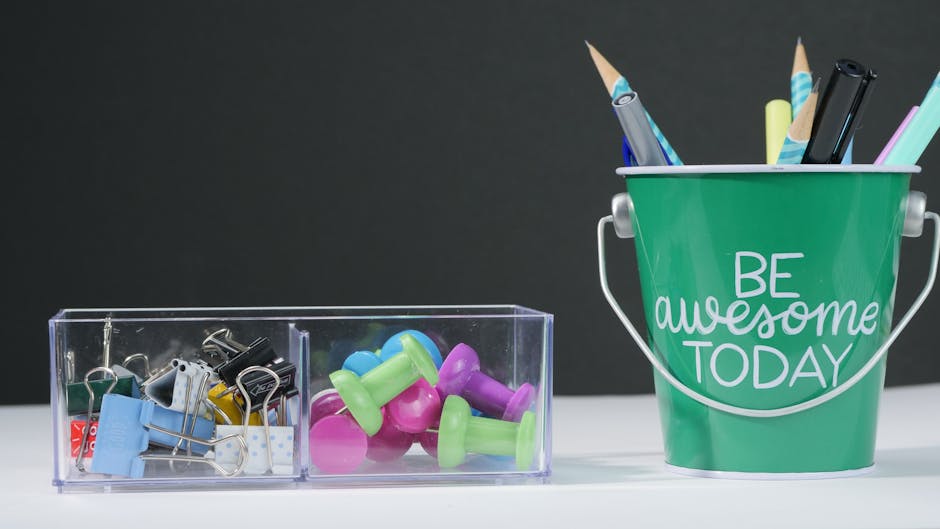
- Pen cup on desk for daily-use pens
- Drawer organizer for backup supplies
- Cabinet shelf for paper and folders
- Designated cable storage
- Label maker for organization labels
Step 6: Implement and Maintain
Place each category in its designated spot. Take a photo for reference. Set monthly maintenance reminder.
For more on workspace organization, see our desk organization guide.
What I Wish I Knew About Office Supplies
After 3 office reorganizations, here is what helped most.
Quality beats quantity. I have 8 quality pens now (Pilot Precise or Pentel EnerGel). They never need replacing. Better than 50 cheap pens.
Pen cup on desk is a game-changer. Daily-use pens in a cup on the desk. Backup in drawer. Never search for a working pen.
Cable management is the silent killer. Old cables for devices you no longer own. Toss aggressively.
Label maker pays for itself. $30 once. Easy labeling of every container, drawer, file folder.
One backup of each. Five backup pens, one backup notebook, one backup tape. More is hoarding.
The 80/20 Office Supplies List
Most home offices function with these supplies:
Writing (5-10 items)
- 5 to 8 quality pens (black, blue ink)
- 2 to 3 colored pens (or markers)
- 2 to 3 pencils with erasers
- 1 highlighter
- 1 sharpie
Paper (3-5 items)
- 1 daily notebook in active use
- 1 ream of printer paper
- 1 pack of sticky notes
- 1 pack of index cards (optional)
- 1 stack of plain paper
Fasteners (5-7 items)
- 1 stapler with backup staples
- 1 box of paper clips
- 1 box of binder clips (small and large)
- Few rubber bands
Adhesives (3-5 items)
- 1 roll of clear tape
- 1 roll of masking tape
- 1 small bottle of glue (optional)
- 1 pack of sticky tabs
Cutting (1-2 items)
- 1 pair of scissors
- 1 pair of paper-cutting scissors (optional)
Storage (5-10 items)
- 5 to 10 file folders (basic)
- 2 to 5 hanging folders
- Label maker
- 1 file box
Electronics (varies)
- Calculator (or phone-based)
- Hole punch (if needed)
- Specific work-related tools
Total inventory: 30 to 50 items, total cost under $100.
Specific Storage Solutions
Pen Cup on Desk
A small cup or holder on the desk for daily-use pens. 5 to 10 pens max.
Best for: Active writing use
Drawer Organizer
A compartmented drawer organizer for backup supplies. Each compartment per category.
Cost: $15 to $40 Best for: Backup storage
Cabinet Shelf
Open shelf in nearby cabinet for paper and bulk supplies.
Best for: Larger quantities
Cable Box or Bag
Dedicated container for cables and adapters. See our cable management guide.
Best for: Cables and electronics
Designated File Box
For active files and reference materials. Hanging folders or file box.
Best for: Active paperwork
Common Office Supplies Mistakes
After helping family and friends:
Mistake 1: Too many cheap pens. Quality over quantity matters.
Mistake 2: No category sorting. Items mix randomly.
Mistake 3: Storing cables loose. Tangles forever.
Mistake 4: Keeping non-working items “to fix later”. They never get fixed.
Mistake 5: Adding new without removing old. Accumulation continues.
For more workspace tips, see our time blocking and WFH routine guides.
Office Supplies for Specific Roles
Remote Worker
Daily needs:
- Quality writing tools (pens, notebook)
- Computer essentials (mouse pad, headphones)
- Cable management (multiple devices)
- Active filing system
- Specialty per role
Student
Specific needs:
- Notebook variety
- Highlighters for studying
- Sticky notes for marking
- Index cards for memorization
- Specific subject supplies
Parent of School-Age Kids
Additional needs:
- Crafts and projects supplies
- Backpack supplies
- Lunchbox items
- School label maker
- Family calendar supplies
Small Business Owner
Higher volume needs:
- Bulk paper and folders
- Shipping supplies
- Business-specific tools
- Receipt and invoice management
- Marketing supplies
Supplies Maintenance
Keep supplies functional with:
Weekly: Toss non-working items as discovered Monthly: Quick audit, restock from designated supply Quarterly: Major review of what’s worth keeping Annually: Big overhaul, donate excess
The maintenance prevents the slow buildup that destroys most office organization.
Going Digital
Reduce supplies by going digital:
Note-taking app: Replace notebooks E-book reader: Replace printed books Digital calculator: Replace physical Cloud filing: Reduce paper folders Digital sticky notes: Replace physical pads
For digital organization, see our digital decluttering guide.
Bulk Buying vs Buying Less
Two approaches:
Bulk Buying
Pros: Lower cost per unit Cons: Storage burden, may not use before degradation Best for: Items you use heavily (paper, sticky notes)
Buying Less
Pros: No storage burden Cons: Higher per-unit cost Best for: Most household supplies
For most home offices, the buying-less approach is more efficient. Quality items used to completion outperform stockpiles.
Family Office Supplies
For households with multiple users:
Designated supplies per person: Each user has their own pen cup Shared family supplies: Bulk items in shared cabinet Kid-specific supplies: Lower height, kid-friendly Labels and assignment: Clear which supplies belong to whom
For more, see our decluttering for families approach (the principles transfer).
Travel and Mobile Office Supplies
For mobile work:
Travel pen pouch: 2 to 3 quality pens Travel notebook: Compact for portability Travel charger and cables: Specific set Travel folder: For documents in transit
Match supplies to mobility needs.
Saving Money on Office Supplies
Strategies:
Bulk buy quality: 1 box of 60 quality pens is cheaper than buying individual Subscribe and save: Amazon, Office Depot for repeat items Quality over quantity: Better pens last longer Use what you have: Don’t buy without auditing first Donate before buying: Make sure space exists
Key Takeaway
Office supplies organization works through aggressive decluttering (test everything, toss non-working) and clear categorical storage. Most homes can reduce supplies by 50 to 70% without missing anything. Use a pen cup on the desk for daily items, drawer organizers for backup, and cabinet storage for bulk. Reduce to 30 to 50 essential supplies total. The setup takes one weekend and saves 5+ minutes per workday in searching for items. Quality over quantity matters: 8 quality pens outperform 50 cheap ones. The maintained system prevents the slow accumulation that creates the chaos.
For more workspace tips, see our desk organization, cable management, and time blocking guides.

Frequently Asked Questions
What office supplies do you actually need?
Essential office supplies include: 5 to 10 quality pens, 1 to 2 notebooks in active use, basic stapler and staples, scissors, tape (1 to 2 rolls), paper clips, sticky notes, basic file folders, basic calculator, and label maker. Total supply budget: under $50 for everything needed.
How do you organize office supplies in a drawer?
Organize office supplies in a drawer using bamboo or plastic drawer organizers with multiple compartments. Group by category: writing implements together, paper supplies together, fasteners together, tape and adhesives together. One compartment per category prevents the scattering that destroys most drawer organization.
Where should you store office supplies?
Store office supplies in or near your workspace: pen cup on desk for daily-use pens, drawer organizer for backup supplies, shelf nearby for paper and folders, designated spot for printer supplies. Keep supplies you use weekly within arm's reach; backup supplies in cabinet or closet.